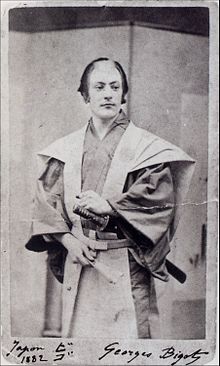
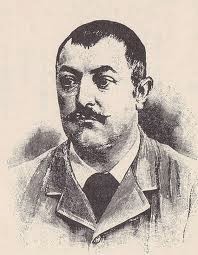
This project showcases student project work from Japan and the World, a modern Japanese history course offered at Kanda University of International Studies. It focuses on important themes and individuals from the Meiji (1868-1912) and Taisho (1912-26) periods, when Japan was beginning to open to the world after centuries of government-enforced isolation.

All submissions are researched, whether in English or Japanese, and references provided. Comments responding to and exploring ideas, suggesting connections or further reading, are most welcome. As entries are written by non-native English speakers, please refrain from non-constructive comments about language use.

Blog editor/ course designer: Caroline Hutchinson
Showing posts with label cartoon. Show all posts

Thursday, 29 January 2015

Georges Ferdinand Bigot

Image 1: Une partie de peche
By Hitomi Takano

Introduction

Do you know this picture (1)? –Yes. Then, do you know about Bigot? -Probably, the answer is ‘No.’. Georges Ferdinand Bigot is a famous French painter who drew a lot of pictures about Japan. His drawings have historic value, and they are included in a history textbook in Japan. That’s why many people might know his works, even if they don’t know Bigot.

Personal history

Bigot was born in Paris. His father was a government official, and his mother was a famous artist. Under the influence of his mother, Bigot was interested in pictures since he was small. When he was 12 years old, he entered the École des Beaux-Arts and studied art until 1876. After he quit his study, he began to work as an illustrator. His work went well, and he gradually became famous. However, when he went to Exposition Universelle de Paris, he was attracted by Ukiyoe (Japanese woodblock prints - Ed), and also by Japan, and finally decided to go to Japan. First, he came to Japan as a oyatoi gaikokujin (a hired foreign expert - Ed), and earned money by teaching art at school. After his employment contract as a oyatoi gaikokujin expired, he began work as a News painter. He reported many disasters with his paintings, and earned a lot of money. Using his salary, he began to publish the comic magazine called TÔBAÉ. In this magazine, he drew a lot of satirical drawings, and created new style of cartoon. He lived in Japan for about 17 years, and came back to France in 1899.

Georges Ferdinand Bigot
Summary of discussion

We discussed two points of Bigot’s accomplishments:

1. If he had been born in different time, Bigot should have decided to settle down in Japan.

-Do you agree or disagree with this opinion?

2. He loved Japan so much, drew a lot about Japanese culture, and also married Japanese woman.

-Why do you think Bigot continued to criticize Japan in his publication?

At first, I asked why Bigot chose to go back to France. In my opinion, Bigot would have stayed in Japan if he was born now. At that time, Japan was gradually becoming more chaotic. For foreigners in Japan, it was extremely dangerous to continue staying in Japan. Many group members agreed with me. In addition, one group member said that if he was born now, he would not become famous. I strongly agree with this opinion. It was fortunate that he was born in the late 19th century because this time period made him famous.

The second question was about Bigot’s character. Through his life, Bigot kept criticizing Japan in his works. However, he also left a lot of episodes to make people think that he loved Japan. Which is his real opinion? In my group, almost all members mentioned that Bigot loved Japan, and because of that, he wanted Japan to grow up more by continuing to point out weak points and problems. I also agree with my group members. If he really hated Japan, I think, he would have not continued staying in Japan for 17 years.

Reflection on person and project

Before this project, I knew Bigot’s works in the same way as majority of people, but did not know well about Bigot. However, while I checked him, I became interested in Bigot. I think Bigot is a Japanophile. He loved Japan so much that he tried to settle down in Japan. However, he didn't do that, and came back to France. This was because he had a lot of difficulties staying in Japan. While he was living in Japan, Japan had two wars, the Sino-Japanese war and the Russo-Japanese war. In this period, foreigners in Japan were sometimes treated badly. Bigot was afraid of Japanese militarism. In addition, he did not get along well with Kuroda Seiki, an authority on the Japanese art. From these facts, he decided to go back to France.

Bigot’s works are important historical materials to know the common customs at that time. They are not only satirical drawings, but also drawings of Japanese daily life. He brought Western style of cartoon to Japan, and also criticized Japanese society with foreigner’s eyes.

I think that it is his misfortune to have been born at this time. If Bigot had been born in different time, maybe his life might have changed.


References

“Georges Ferdinand Bigot”. (n.d.). In Wikipedia, accessed December 2014:
http://ja.wikipedia.org/wiki/%E3%82%B8%E3%83%A7%E3%83%AB%E3%82%B8%E3%83%A5%E3%83%BB%E3%83%93%E3%82%B4%E3%83%BC

Shimizu, I. 2001. Bigot ga mita Nihonjin [Japanese people as seen by Bigot]. Tokyo: Kodansha

Shimizu, I. 2006. Bigot ga mita Meiji Nippon [Meiji Japan as seen by Bigot]. Tokyo: Kodansha


Make serious situation FUN!!

Image (2)
Image (1)
by Akari Matsumoto

Have you ever seen these pictures (1, 2)? You might have seen them when you were in junior high school or high school. These are helpful materials to understand history. Do you know who drew them? The answer is ... Georges Ferdinand Bigot. He is famous as an caricaturist (3).
Image (3)


Who is Bigot?

He is from France. He come to Japan as お雇い外国人(Oyatoi-gaikokujin - a foreign expert - Ed).

Why was he interested in Japan?

He studied drawing when he was in France. Through drawing he met people who loved Japanese art. And he saw Ukiyoe (Japanese woodblock prints - Ed) at Paris Exposition.

Then he became interested in Japan.

Did he draw political pictures at first?...No!

He began drawing Japanese daily life at first. It was rare thing because at that time Japanese people didn't care about daily life, because it was too usual so they didn't draw it. What he did next was drawing Government and international relations. At that time there were French people who were interested so he drew pictures for them.

As you know pictures help our imagination. In particular, it's hard to understand politics, so his pictures were good for French people. His pictures include humor like funny comics. It makes people have interest.

His thoughts about Japanese politics

He had opinion about Treaty revision (条約改正). Treaty revision is amending situation that Japan admit Extraterritoriality (治外法権) and doesn't have Tariff autonomy (関税自主権) and so on.

Extraterritoriality meant that Japan couldn't judge if foreigners committed crimes, even though it happened in Japan. Japan has to leave it to the country of the person who committed the crime.

Image (4)
Tariff autonomy means ability to set tax on trade. At that time, Japan didn't have it, so Japan had to follow tax which other countries set. If I were alive at that time, I might think Japan had to do Treaty revision soon, because I’m Japanese and these treaties are unfair for Japan. Japan didn't have right. On the other hand, Bigot didn't think so. Treaty revision might be not good for foreigners, including Bigot. Finally he left Japan.

His work is not famous in his country France but in Japan, his pictures are so important.

By the way, what do you think stereotype of Japanese people is? You might imagine like this picture (4). Japanese is short, wearing glasses, has an overbite, is working hard and so on. People say these images are made by Bigot.

These two are pictures Bigot drew:
Image (5)

Image (6)
But Bigot doesn't always drew Japanese like these and make fun of Japanese. He loves Japanese and respect Japanese.

I like Bigot

I like art and history. Sometimes, history is complicated especially world history is hard for me. But thanks to his work, his cartoons, I can understand.


His cartoon makes serious situation like world relationship fun for example he draws country as person (7). It is easy to understand.

↓ Russia,Japan,UK and USA

Image (7)


One disappointing thing is he didn't understand Treaty revision. I hope he would cooperate with Japanese to do Treaty revision.


References

"Georges Bigot". (n.d.) In Wikipedia. Retrieved January 19, 2015, from
http://ja.wikipedia.org/wiki/%E3%82%B8%E3%83%A7%E3%83%AB%E3%82%B8%E3%83%A5%E3%83%BB%E3%83%93%E3%82%B4%E3%83%BC

Naver Matome, (September 19, 2013). Furansu no Fuushigaka, Georges Bigot ga Mita Nihonjin [Meijijidai] [Japanese people as seen by French caricaturist Georges Bigot - Meiji Period]. Retrieved January 19, 2015, from http://matome.naver.jp/odai/2137904355726810601?&page=1

"Sutereotaipu" [Stereotypes]. (n.d.). In Wikipedia. Retrieved January 19, 2015, from
http://ja.wikipedia.org/wiki/%E3%82%B9%E3%83%86%E3%83%AC%E3%82%AA%E3%82%BF%E3%82%A4%E3%83%97


Sunday, 3 August 2014

Georges Ferdinand Bigot

Georges Ferdinand Bigot
By Yui Yamamoto

Life of my focus person

Most Japanese people have seen before the picture called “gyou fu no ri (漁夫の利)”. It is one of Bigot’s masterpieces which shows the complicated international situation among Japan, China, Russia and Korea. It is drawn by a famous French cartoonist, Georges Bigot. Bigot was born and raised in Paris and learned at École des Beaux-Arts. After he started working as an illustrator, he was interested in “Japonisme” and decided to come to Japan in 1882. He learned Japanese and lived in Japanese community and frequented red-light districts (yukaku gayoi) to know more about Japan.

Although Bigot is generally known for cartoons in Japan, there are plenty of genre paintings which showed daily life and social conditions faithfully at Meiji period. For example, in a drawing of voting, there are many Japanese men in Western clothes who have Western hairstyles or mustaches. It showed that only high-class men had voting rights and participated in political events. The most significant point of this picture is a man who is wearing Kimono and has a Japanese topknot. His style is really rare in that situation, as can be seen from other men. A cartoon magazine produced and released by Bigot, called “TÔBAÉ”, was published for foreign residents in 1887. It was organized his critics such as the Japanese government. At present, those works are really important historical materials.


Summary of discussion

Q1. What do you think / how do you feel about his drawings?

Q2. Imagine if you were Bigot, what would you draw about present Japan?

Initially, listeners were impressed by the works especially cartoons for the first question. They had same opinions as mine that the pictures explained as they are. I thought that they have already known his works so it was easy to think. Although the second question was a little bit tricky for them, we could share some ideas at the end of the discussion. Most of them talked about Japanese problems such as Fukushima problems, the relationships between Japan and the U.S. and so on. On the other hand, only few ideas about our present daily lives were shared. I thought that it was not easy for us to see ourselves as others see us.


Reflection on person and project

Through this project, I learned that Bigot had really critical eyes. At first, I did not know that he drew various works as well as cartoons. For example, there are “Japanese” who he admired in his genre pictures. Also, they showed real daily lives in Meiji period. Therefore, I realized again how he saw Japan clearly, calmly and carefully. I am surprised that we are in the same situation of his works. In fact, there are plenty of types of media and they are playing a major role in the sharing of information. However, the government is still strict about them even though Japanese people want to know the truth. I think the picture shows us that it is significant to have various “eyes” on your mind.


References

Shimizu, Isao. 2001. Bigot ga mita Nihonjin. Tokyo: Kodansha

Shimizu, Isao. 2006. Bigot ga mita Meiji Nppon. Tokyo: Kodansha

Georges Ferdinand Bigot

Georges Ferdinand Bigot
By Hatsumi Yoshino

His background

Have you ever heard the name Georges Bigot, or seen his art works? He was famous as an artist and a cartoonist. He was born in 1860 in France. His mother graduated from a famous artist school and he lived around arts so he was interested in arts and paintings. After graduating from art school, he met a French artist known to be a Japanese art enthusiast and he learned about Japanese arts or Japan from him so he became interested in them. In 1882, he came to Japan and he worked at Japanese military as a foreigner employee. After that, he taught French at Nakae Chomin’s school and he contacted Chomin’s apprentices, so he learned of campaign for democratic rights. Because of this experience, he began painting critical cartoons. In 1887, he published “TOBAE” to criticize Japanese government for foreigners living in Japan. In 1893, before coming back France, he moved to Inage, Chiba and in same year he followed Japanese military to record Sino- Japanese war. In 1889, he came back France.

Three elements influenced his life. First is his mother and his friend, second is Nakae Chomin and third is Sino-Japanese war. I suggested that the first influence was his mother and his friend. His mother graduated from a famous art school so he was interested in arts. When he was 8 years old, he drew states of the Paris commune. His art style of painting real life also came from this experience. In addition he met his friend who liked Japanese arts. At first when he met his friend, he was taught Japanese ukie, not critical cartoon. However he could know Japanese art, he wanted to go to Japan.

Next is Nakae Chomin. Bigot taught French in Chomin’s school. Its school was attended by students who achieved the campaign for democratic rights. So Bigot could know Japan’s politics and he began to paint critical cartoons. At that time Japanese government wanted to change a treaty between Japan and other countries. However Bigot disagreed with this opinion, and thought it was too early to change them. So he criticized Japanese government with his cartoons.

Last influence is Sino-Japanese war. Bigot followed Japanese military to record this war. He painted hospitals of the battlefield or soldiers who did trivial works. In Russo –Japan war, he was asked to paint its war.

My influence

Indiscriminate imitation
I saw Bigot's pictures when I was a junior high school student and a high school student in history classes. At first I was surprised that a foreigner painted these pictures. Because I think they could not directly criticize Japan but he painted them like a cheating. However they were true viewpoints which foreigner had. My favorite picture is “Indiscriminate imitation”. This picture shows Japanese couple wearing dress and they think this dress suits them, but two monkeys are reflected in the mirror. According to this picture, Japanese is equal to monkey and they did not really westernize. They just imitated western country. I think Bigot looked at Japan critically. Some other foreigners also expressed criticisms in their books or pictures. Bigot’s picture was easy to understand, because people who did not know English could not understand books in English, but pictures did not have letters so they could understand artist’s feelings easily.

Explaining our discussion

I would like to explain our group discussion. My first discussion question was “If you lived in that time, and you saw Bigot’s picture, what would you have felt?’ Second is “Bigot was not famous in France but he was famous in Japan, so do you think he was happy or unhappy?” Last question is “what are differences between Edoardo Chiossone [an Italian portrait artist described in other posts on this blog - Ed] and Bigot?”

First discussion question was “If you lived in that time, and you saw Bigot’s picture, what would you have felt?’ A group member said if I could understand that the pictures looked down on Japan, I would have gotten angry. Other members said they would have got angry or sad.

Second question was “Bigot was not famous in France but he was famous in Japan, so do you think he was happy or unhappy?” A member said he might have been happy because he was interested in Japan and loved Japan. In addition I explained that he got award for his picture which he painted in Inage, so after hearing this fact, members said he was so happy because he painted his favorite view in Japan, so he was happy.

Last question is “what are differences between Chiossone and Bigot?” My group member introduced Chiossone who was Italian painter and he painted Japanese good points or contributed to Japanese government. They were opposite, so what are differences? A member mentioned Bigot just joked and he did not really criticize Japan. Because he loved Japan and he wanted to introduce real Japan to foreign countries.

Thanks to this presentation, I could know details of Bigot and I want to research him more. Many foreigners who I do not know contributed to Japan. Present Japan is made by not only Japanese but also foreigners.

References

Bigot’s Wikipedia

http://ja.wikipedia.org/wiki/%E3%82%B8%E3%83%A7%E3%83%AB%E3%82%B8%E3%83%A5%E3%83%BB%E3%83%93%E3%82%B4%E3%83%BC

http://en.wikipedia.org/wiki/Georges_Ferdinand_Bigot

Tuesday, 4 February 2014

Georges Ferdinand Bigot

By Minami Kikuchi

Have you ever seen Picture A? Probably, most people have seen this picture in the textbook of history. This picture expresses Japan and China which are going to get Korea, and Russia which plans to seize it, in the Sino-Japanese War age. This picture was drawn by Georges Ferdinand Bigot who is famous as cartoonist, illustrator and artist.

Georges Ferdinand Bigot was born in Paris in 1860. His father was a government official and his mother was a painter. Under the influence of his mother, he began to draw a picture when he was very young. He entered École des Beaux-Arts (School of Fine Arts) in 1872 and studied pictures. However, he quit school in 1876 in order to help the family budget. Then, he began work of the illustration. He went to the salon many times, and he got the knowledge about Japanese arts there. He encountered Ukiyoe [Editor's note: woodblock prints] for the first time in Paris Exposition in 1878, and he got interested in them. In this time, he was already well known to many people in France. However, his thought about Japan was strong so he came to Japan in 1882, when he was 21 years old.

In order to know the life of Japanese people, he did not live in a foreign settlement but he lived in the town in which Japanese people live. Moreover, he went to the licensed quarter (遊郭) often in order to know Japanese society. Based on them, he drew and put many caricatures about Japanese politics in the caricature magazine "TÔBAÉ" which was first published in 1887. After that, his work became stable, and he got married to a Japanese woman in 1894. However, after Japan won the Sino-Japanese War, he started to worry about his livelihood because the photograph developed from that time and work of news painter decreased sharply. Moreover, he held distrust for Japanese administration of justice and police. Therefore, he divorced and returned to France in 1899. He remarried French woman immediately after the homecoming and he died because of a stroke in 1927, when he was 67 years old.

He drew the social trend of Japan of those days which Japanese people did not get interested in because it was too natural for Japanese people to make their subject matter. Therefore, his works has become valuable Japanese data now. The picture which he drew about the Sino-Japanese War often appears in the school history textbook which we used. In his work, there are many picture which are put into two or more segments of frames (コマ) and have a story, like Picture B. Someone said, "He brought the style of the long segment comics of Europe to Japan."

He had dissatisfaction with the Japanese government and there were depictions which can be thought to be government criticism in TÔBAÉ. However, I think that he liked Japanese tradition and culture because it is said that he made the Japanese garden at the house in France and looked at it every day. It may be a reason why he was criticizing Europeanism of Japan strongly, although he loved Japanese culture.

Picture A - Sino-Japanese War

Picture B - Sample of Japanese comic style

References

France no huushi gaka, Georges Bigot ga mita nihonjin [The Japanese which is a French caricaturist Georges Bigot looked at.] (2013, September 9). Yuunayun Retrieved 2013, Jan 6 from http://matome.naver.jp/odai/2137904355726810601

Georges Bigot (2010, October 13). Hongo mura dayori Retrieved 2013, Jan 6 from http://blog.bunsei.co.jp/2010/10/13/%E3%82%B8%E3%83%A7%E3%83%AB%E3%82%B8%E3%83%A5%E3%83%BB%E3%83%93%E3%82%B4%E3%83%BC/

Georges Bigot (2013, May 1). LAMBIEK Retrieved 2013, Jan 6 from http://www.lambiek.net/artists/b/bigot_georges.htm

Sunday, 4 August 2013

Georges Ferdinand Bigot

By Kumiko Omura

Georges Ferdinand Bigot is a French cartoonist and illustrator born in 1860. A picture below is very famous for one of Bigot’s cartoons, gyofu no ri. It is depicted well in the cartoon that Japan and China competed for domination of Korea, and Russia watched carefully to usurp Korea. This cartoon explains the relationships among Japan, China and Russia in the Sino-Japanese War which occurred in 1894. Most Japanese will have seen it in text books at least once.

Bigot's famous cartoon depicting relations between Japan, China, Russia and Korea

Bigot was born in France and encouraged into art by his mother, and he was accepted by the Ecole des Beaux-Arts in Paris at the age of 12. However, he quit school when he was 16 years old to earn a living for his family, and he began to contribute illustrations to newspapers and magazines. In 1878, he visited Paris International Exposition and knew Japan through the exhibition. It motivated him to have strong interest in Japan. Finally, he arrived at Yokohama at the age of 22. In 1882, there was a foreign settlement in Yokohama, but he never lived there because he wanted to draw Japanese daily life outside the settlement. He was hired as an oyatoi gaikokujin and taught watercolor painting at the Imperial Japanese Army Academy for 2 years. Oyatoi gaikokujin is a foreigner hired officially by Japanese government from the end of Edo Era through Meiji Era to advance Japanese modernization.

Bigot published his own magazine TOBAE while he stayed at Japan. TOBAE was a satirical cartoon magazine targeting Japanese politicians, and its readers were mostly foreigners living in the settlement. It was TOBAE in which gyofu no ri, mentioned before, appeared. TOBAE was first published in 1887 and continued until 1889, in the midst of the Freedom and People’s Rights Movement. This was a campaign to request establishment of a national assembly legislature from 1874 through 1890 in Japan. Bigot aimed to criticize politics and Japanese society through TOBAE and claimed what they should be (2006, Shimizu, p.g. 38-39). He sent TOBAE to newspaper publishing companies, magazine publishing companies and journalists to try to influence them. Chomin Nakae, who was a leading figure of the campaign, helped him to caption cartoons in TOBAE. On 11th February 1889, the Constitution of the Great Empire of Japan was promulgated, and then the Freedom and People’s Rights Movement came to an end (2006, Shimizu, p.g. 132). This constitution was enforced until Japan lost the Second World War. After that, he mainly played up the treaty revision in TOBAE. He stated that it was too early for Japan to revise treaties because Japanese legal code had not been completed yet (2006, Shimizu, p.g. 143).

In 1894 at the age of 27, Bigot followed Japanese military as a special correspondent of British newspaper The Graphic and went to the front of the Sino-Japanese War. This event led his career as a news painter and shifted his theme to the Far East Asia situation. His paintings from the field had things that the mass media hardly took up. After the Sino-Japanese War, readers of his magazines decreased because they feared the abolition of foreigner settlement and returned back to their countries. He also decided to go back to France a month before the treaty revision realized., at the age of 32.

It was after the Second World War that Bigot's cartoons became widely known to Japanese people. Bigot came to Japan longing for Japanese ukiyoe and really loved Japan, especially Japanese masses. He left many drawings of Japanese masses, and began to depict people in the middle and higher classes when he published TOBAE. At that time, it was difficult for foreigners staying at Japan and masses to see the lives of people in the upper class. He reported their life to foreigners and masses through his drawings. He totally recorded Japanese people and society in the end of 19th century on drawings as a cartoonist, an artist or a journalist. Bigot’s works helped Japanese in Meiji to fill the gap between classes from the point of view of a foreigner, and gave foreigners in the settlement chance to know better Japanese lives from masses to the higher class. His cartoons are very precious and helpful for us today to visually know Japanese life in Meiji Era when was short of visual materials, too (2006, Shimizu, p.g. 11-12).


―Reference―


Simizu, I. (2006). Bigo ga Mita Meiji Nippon [Bigot and Japan in Meiji]. Tokyo: Ko-dan sha