This project showcases student project work from Japan and the World, a modern Japanese history course offered at Kanda University of International Studies. It focuses on important themes and individuals from the Meiji (1868-1912) and Taisho (1912-26) periods, when Japan was beginning to open to the world after centuries of government-enforced isolation.

All submissions are researched, whether in English or Japanese, and references provided. Comments responding to and exploring ideas, suggesting connections or further reading, are most welcome. As entries are written by non-native English speakers, please refrain from non-constructive comments about language use.

Blog editor/ course designer: Caroline Hutchinson
Showing posts with label gakushuin. Show all posts

Tuesday, 4 February 2014

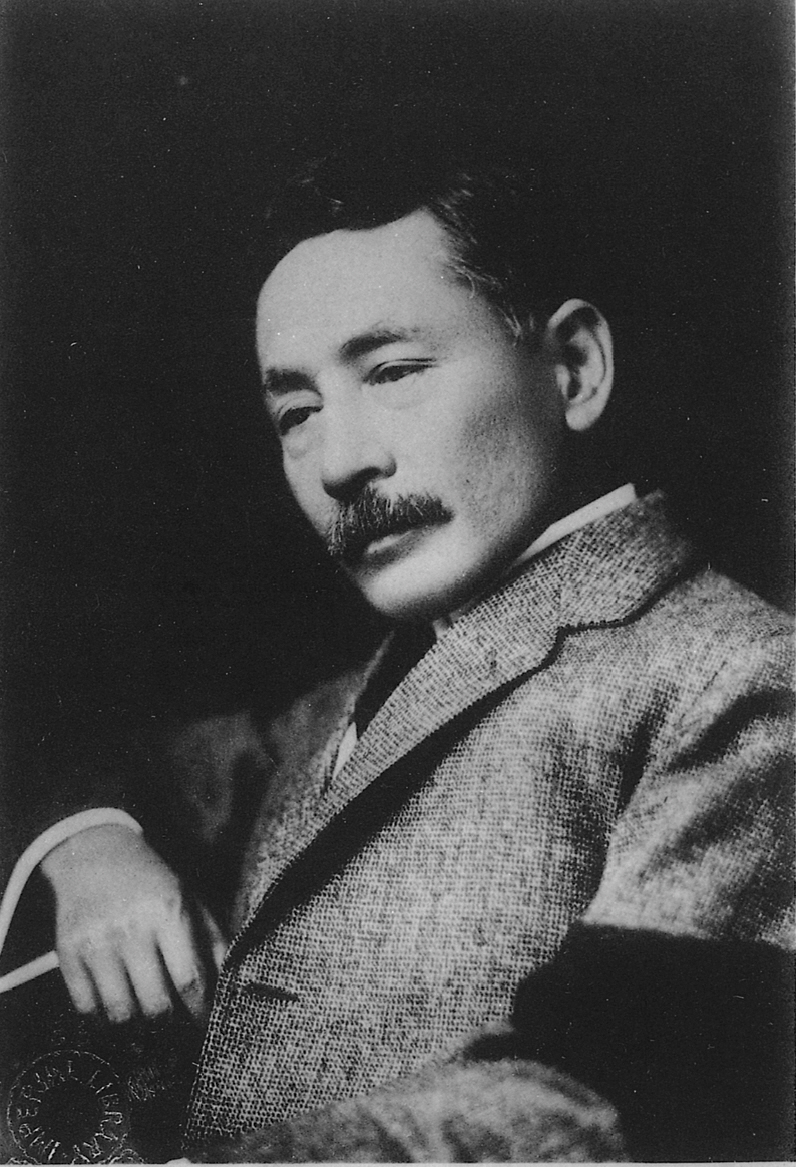
Natsume Soseki

Natsume Soseki
By Haruka Takenawa

I would like to present Natsume Soseki’s growth, experience and the effect on his character, and his contribution to society at that time and this time. The reason why I chose him is I was interested in his literature when I was junior high school student. I would like to know his personal side. I think his personal background and experience must have influenced his works, and have given a lot of ideas to his works. That is why I chose him.

Firstly, I will mention three main points about Soseki’s growth: his family, study in Japan, and study in Britain.

Soseki was born in 1867. At that time, Japan was full of upheavals. The Meiji Restoration [Editor’s note: defeat of the Shogunate and restoration of rule by the Emperor] had happened, and Sakamoto Ryouma and Nakaoka Tarou had been killed by Bakufu [the ruling Shogunate]. His father was a village head, so Soseki’s parents’ home was rich. His mother had many children. He had four brothers and three sisters. However, Soseki was not a wanted child. His parents’ treatment of him was terrible. His parents had never treated him as their child. Soseki was born in rich family, but not an amiable family. He was sent to a merchant family by his father as soon as his birth. Unfortunately, his adoptive father and his father had a trouble, so he went back to his house where he was born. The trouble between them continued until Soseki entered ASAHI press when he was 40 years old. That experience, and his domestic environment, gave him the ideas for “Michikusa”.

He acquired culture at ten different schools and Universities. He changed his learning place many times. He mainly learned English literature, because he was really interested in English. When he entered Nishyougakushya University, he learned ethics, the western sense of beauty, and Edo’s sensitivity. He had an outstanding brain, so he was the head of his class in all subjects especially English. He became an honor student of Tokyo University. As a result of his outstanding work, he got job from his professor to translate “Houjyouki” (Kamakura era masterpiece). He met Masaoka Shiki at Tokyo University, and they became best friends and haiku companions.

Governor let Soseki to study in Britain. Soseki was inspired by European thoughts, education, and their way of living. Also he could concentrate on his study of English literature. “MY INDIVIDUALISM” was inspired by their ideas of “Freedom”. British freedom meant one had to have the responsibility to be free. However, Japanese freedom was totally different. Through his studying in British, he found that an ideal English teacher is a person who has studied overseas then mastered English as a communication tool. Furthermore, he got many ideas about educational style.

Secondly, I will mention his experiences and the essential points to build up his character. I will focus on the literature, his friends, and illness.

He loved not only writing but also reading. He is famous for loving foreigner’s literature. When he went abroad to Britain, he read Jane Austen’s literature with pleasure. It is not an exaggeration to say that his literature was influenced by her works.

He had a lot of precious friends. When he was 22 years old he met Masaoka Shiki at Tokyo University. Soseki was impressed by Masaoka’s haiku and became his haiku companion. They improved each other so that Masaoka is necessary for Soseki’s works and Masaoka was too. Thanks to Shiki’s friend Takahama kyoshi (literature companion), Soseki became a full time writer. Soseki had neurasthenia (a nervous breakdown) so Kyoshi believed that if Soseki focused on his works, he would be able to forget his uneasiness. He had not only literature companions; he also had friends for boat race, and gymnastics. He was really interested in boat race and good at gymnastics. He had good relationships with them.

Soseki had really poor health. He had serious illnesses more than fifteen times. He suffered from illness from only three years old to when he died. His one-year-old fifth daughter died when he was forty-four years old. Her cause of death was uncertain, because of that, Soseki decided to ask his doctor to examine his body by dissection after his death.

Lastly, I will mention his contribution to Japanese society at that time and this time, focusing on his works, his educational style, and his famous speech at Gakushuuin University.

He produced about 37 masterpieces in his short life. His works give his reader great impact even now. “KOKORO” is really meaningful novel because depending on the age, each generation feel differently. That is why it is difficult to understand his works. Its psychological description lets reader consider deeply. The time background is of course different from these days, however the characteristics are related to us. ASAHI press took a survey to ask audience which writer is the best writer in Japan of the past thousand years. The most popular writer was Natsume Soseki.

Soseki taught mainly English at about six different Universities, junior and high schools such as Meiji, Tokyo, and Waseda University. Soseki carefully considered not only his teaching style but also how to build up students’ character. His teaching style was incredible, because he had already found that to unite grammar and communication is the best way to learn English. That idea had just started in 2013. I was so surprised to know that. His educational style was very practical, because he thought English was a tool to communicate, not for study.

“MY INDIVIDUALISM” was a speech given by Soseki at Gakushuuin University. When I read it, I was so impressed, because he noticed that Japanese society’s fault even though it was 1914. His quote must have influenced many people even now. He told the students three main topics. Firstly, “If you want to be free, you have to accept other’s freedom.” Secondly, “If you want to use your right, you have to have its duty.” Lastly, “If you want to use your power of money, you have to think about its responsibility.” After he left such meaningful speech, he passed away when he was 49 years old.

In conclusion, I have mentioned Soseki’s growth, experiences, and contribution. I noticed that he had a lot of setbacks. Through his difficulties, he made lots of outstanding and meaningful works. I think his setbacks are his works’ essential items. He had to have serious illness. However, the motivation to produce his works was his limited life I think. In learning about his background, Soseki taught me fortitude. Even we have difficulties, we should overcome our difficulties and should not give up.


References

Kimura. (1998). Natsume Soseki’s history. Retrieved May 5, 1998, from Biglobe web site: http://www2a.biglobe.ne.jp/~kimura/senpu.html

Koki, K. (2000). Natsume Soseki as English teacher. Japan: Shintyosya Institution Press.

Mizuho, I. (2004). Soseki in London. Japan: Seibundou Institution Press.

Soseki, N. (1978). MY INDIVISUARISUM. Japan: Kodansha Institution Press.

Monday, 5 August 2013

Alice Mabel Bacon (1858-1918)

By Satsuki Konno
Alice Mabel Bacon
Alice Mabel Bacon


Can you guess the woman who correctly analyzed Japanese girls and women? Her name is Alice Mabel Bacon. She was an American writer, women’s educator and foreign advisor.

First I would like to introduce her background. When she was 14 years old, Mori Arinori chose her father’s home to host Oyama Sutematsu, who was one of the people who established Gakushuin Women’s School. These girls were like sisters and taught each other their cultures.

In 1888, Bacon was invited to Japan by Oyama Sutematsu to teach English at Gakushuin Women’s School. She went back to America after a year. When she was 42 years old, she was invited to Japan again to help establish the Tokyo Women’s Normal School (Ochanomizu University). In addition, she taught English at this school and Women’s English School (Tsudajuku University (http://en.wikipedia.org/wiki/Alice_Mabel_Bacon).

Second, let me explain about one of her famous books. The title is “Japanese Girls and Women”. It was written about Japanese girls and women in upper class, middle class and lower class at Meiji period. I think this book is important and easy for people all over the world to study Japan because her analyses are very clear. In addition, this is recommended to foreigners as the book which is the most suitable teaching material for learning about Japan.

I will introduce one chapter (“Wife and Mother”) from her book because Bacon wrote the differences and similarities between women in upper class and in lower class / America and Japan.

During the Meiji Period, American society had the individualism, so it was difficult for Americans to understand the Japanese custom in which women received pressure from husband’s family (Bacon, 1891, p77 [p72]). In the next two paragraphs, I would like to talk about the life of women as a wife and mother.


As a wife

In upper class, wives are treated as the person in charge of housework, so they have to render husband a service and built a happy home. If husband lives selfishly, nobody criticizes them. However, if family meets with a misfortune because of husband’s failure, wife is criticized because she should compensate for husband’s weak points. Husband and wife are unequal. “In all things the husband goes first, the wife second” (Bacon, 1891, p79 [p75]). For example, when husband drops his folding fan or handkerchief, wife should pick up it. Bacon (1891, p79-80 [p75-76]) said an ineffectual person serves an able person as servant serves his/her master. In other words, wives depend on their husband. However it doesn’t mean that they are unhappy because they proud of their duties which they handle the housework and bring their child.

On the other hand, Bacon 1891 said:
“The difference between the women of the lower and those of higher classes, in the matter of equality with their husbands, is quiet noticeable. The wife of the peasant or merchant is much nearer to her husband’s level than is the wife if the emperor. Apparently each step in the social scale is a little higher for the man than it is for the women, and lifts him a little father above his wife.” (p92 [p90-91])

In lower class, husband and wife work in the field together, carry same loads and these women are related to the production directly. It makes men and women’s rank become close. Differently from the upper class, strong men protect weak women. This point is similar to American society.

This paragraph is about women’s life as a wife. I want to be in lower class because I want to work with husband and understand each other’s feeling. In addition, depending on husband would make me tired.

Next, I will explain about the women’s life as a mother. Actually, there are no differences between women in upper class and lower class / America and Japan.


As a mother

Women in upper class and the lower class / America and Japan love their children and devote their life to children. Only mother has the responsibility for bringing up children, so father cannot related to disciplines of them. However, mother teaches children that their father is more dignified in the family. I can understand women’s feeling. If I will be a mother, I would like to bring up my children like this.

In conclusion, although Bacon was not Japanese, she analyzed Japanese women at Meiji Period. The reason why could she do this is that she was influenced by Oyama Sutematsu who was her best friend and made effort to women’s education with her. When they were young, they spent all of time together, and when they grew up, Sutematsu invited Bacon to Japan to establish schools for women. For writing “Japanese Girls and Women”, Sutematsu was very important to Bacon.


Reference list

Bacon, A.M. (2001). 明治日本の女たち[Japanese Girls and Women] (revised edition). Boston / Boston: Houghton, Mifflin and Company

About her background

*Alice Mabel Bacon-Wikipedia, accessed July 13, 2013

Website: http://en.wikipedia.org/wiki/Alice_Mabel_Bacon


Sunday, 4 August 2013

Natsume Soseki

By Saki Rokuhara
Natsume Soseki on the old 1,000 yen note


Natsume Soseki was a famed Japanese novelist of the Meiji Era (1868–1912). He became the portrait on the thousand-yen note in old days. Therefore there would not be anyone who does not know him in Japan. He is best known for his novels Kokoro, Botchan, I Am a Cat, and his unfinished work Light and Darkness. My image of Soseki is that he could speak English well, he had an excellent record and he is the famous writer. However the reality is a little less positive. He grew up in an unhappy environment. I am interested in his life though his surroundings. That is why this essay focuses on three points of his life: his background, people who were around him and what he has contributed to modern society.

First, Soseki was born Natsume Kinosuke in Edo in 1867. However he had a difficult childhood. He was sixth child and unwanted by his family. His mother was 40 years old and his father was 53 so it was late in their lives (Books and writers, 2008). He was sent to live with a childless couple from 1868 to 1877, but they divorced so he returned to his home. His mother died when he was 14, and his eldest brothers died in 1887. In 1893 he became an English teacher but he was worried about many things, including his disease, and English literature as learned by Japanese. Therefore in 1895 he resigned as teacher in Tokyo and he went to different school in Ehime where he continued teaching.

Second, I will talk about people who were around him. Natsume Soseki and Masaoka Shiki were classmates in their cram school. They met in 1889 and they were influenced by each other. Tohoku University Library (2003) said that “In May 1889 Soseki contributed a critical essay to a collection of Shiki's compositions. It is reasonable to suggest that their parting was foreseeable for them from the outset: it is said that Shiki was diagnosed as being tuberculosis of the lungs during this period and realized he had "only ten years" to live.” That is why I think they formed a close friendship. Shiki taught Haiku to Soseki. They were the same age but Shiki was conceited so he treated Soseki like a younger brother (Hoshimiruhiro, 2010). It was Shiki Masaoka who acted as a middleman for Soseki to become a novelist. However Shiki was already dead when Soseki started writing novels. Shiki died in September 1902 during Soseki's stay in England (Tohoku University Library 2003).

Finally, Soseki published many books and he made speeches. Tohoku University Library (2003) said that “Influenced by Shiki, Soseki composed Chinese poems and haikus. Later, encouraged by Kyoshi Takahama, one of a disciple of Shiki, Soseki published I am a Cat in Hototogisu, a magazine started by Shiki.” Soseki gave a famous speech to students at Gakushuin school in 1914. This speech was called My Individualism. He talked about his experience of growing up in the early Meiji era. He argued that it was important for everybody to find their individual identity, but also to respect other people’s individualism as well. Books and writers (2008) says that “In 'My Individualism', a speech delivered to the students of the Gakushuin, an elite academy, he said: "... a nationalist morality comes out a very poor second when compared with an individualistic morality. Nations have always been most punctilious over the niceties of diplomatic language, but not so with the morality of their actions."

In conclusion, I think Natsume Soseki was probably quite good at communication in the sense of his language skill and understanding of people. However maybe he was a high achiever. That is why he was unhappy in spite of the fact he could speak English by going abroad. Moreover the background of his speech is Japanese who were learning about English literature. Could Japanese understand English literature? If a British judgment was different from one's own judgment as a Japanese person, could you insist on your opinion? (Shirolog, 2007). I think this speech is very important even now.


References 

Books and writers, (2008), Natsume Soseki, Retrieved 20 July 2013, from http://www.kirjasto.sci.fi/natsume.htm

Hoshimiruhito, (2010), Shiki to Soseki, Retrieved 25 July 2013, from http://morinnko.cocolog-nifty.com/blog/2010/03/post-caee.html

Shirolog, (2007), My individualism, Retrieved 25 July 2013, from http://blog.hakoniwa.net/archives/404

Tohoku University Library, (2003), Natsume Soseki Library, Retrieved 24 July 2013, from http://www.library.tohoku.ac.jp/collect/soseki/

Friday, 2 August 2013

Peculiar women's culture in Meiji Japan

Alice Mabel Bacon
Alice Mabel Bacon
By Chihiro Oka

Alice Mabel Bacon was a specialist of Japanese culture and women. In Japan, she taught English at Gakushuin Women’s School for aristocratic families. She left Japan once; however, she came back to Japan to establish Tokyo Women’s Normal School (now Ochanomizu University), and basically helped Tsuda Umeko who was a Japanese educator for women. She spent a time in Japan, and experienced a lot of aspects of Japanese women’s lives. Today, Japanese women are mostly free to choose working or being house worker, and almost all Japanese women are free to live. However, in Bacon’s life, she realized and considered Japanese women’s peculiar lifestyle. When people think about Japanese women in Meiji period from 1868 to 1912, it is important to focus on her experiences in Japan. Then, it is necessary to consider about three aspects of education, marriage and women’s different status in Japan.

The first important thing to think about women in Japan is education. Bacon (1902) said that there were no chances for women to get education at school. It means there were no schools for women. Then, how did they study, or could they study? Actually, they had to study from reading books, and obtained way of writing and reading Japanese language without schools. In general, there was thinking that women’s culture in Japan should be manners, writing skills, and liking the tea ceremony or flower arrangement. Those were forgotten study for women. To get knowledge of these things, they had to go to teacher’s house. Although there were no schools, women could write and read Japanese, and learn Japanese manners. However, these customs changed since Commodore Perry came to Japan and the country began to open to the West. Schools for women were established, and women could get education. They could study not only manners or writing and reading skills, but also mathematics or foreign languages. Moreover, there were not problems of women’s status in society. Both high class and low class women were able to go to school to study. Bacon thought that there were a lot of things to study, and it was hard for men and women to do them. However, she felt that Japanese people were hard workers.

The second thing is marriage for women. Bacon (1902) said that Japanese women usually got married when they are 16 years old. They were able to say whether the person who would be their husband was good or bad. However, it was not allowed to refuse a marriage. After they married, there were big differences between American style and Japanese style. In America, a young couple had their own house. On the other hand, Japanese couples did not. Wife had to live with husband and his family. Women had to be more involved with husband’s family than her family. In addition, if women wanted to get a divorce, it was hard for them, because men have a parental authority, so women had to leave their children. Moreover, if women can have a parental authority, it was hard and difficult for them to make their lives. System and condition for women were not fair when it was compared with men. Bacon was surprised at the situation. She thought that different status between men and women were related to areas and social status. It means women in a city and high class had big differences from men, and women had to follow them. On the contrary, women in country and low class did not have big differences from men. Men thought that women were almost equal to them.

The last thing is women’s status in society and family. There were big differences of status in family between high and low class women. Bacon (1902) said that low class women were fuller of life than high class women. Low class women worked in the field with men. This living condition makes women almost same status with men. On the contrary, high class women had to be a servant of husband’s parents. High class women gave up their freedom, and obeyed them. Therefore, Bacon (1902) explained that high class women looked more tired than low class women. She felt that Japanese women who worked were attractive, and it was Japanese peculiar virtue.

In conclusion, the women’s lifestyle was different between high class and low class status, and at the same time, the relationship between men and women was also different. When Bacon considered about women’s lifestyle in high and low class, low class women are happier than high class women because of working. It means that working is important for women to make their life better. There are human rights, and men and women have to be equal, and women should study and work in society.


Reference


Alice Mabel Bacon (1902), 明治日本の女たち [JAPANESE GIRLS AND WOMEN], Boston and New York, Houghton, Mifflin and Company