This project showcases student project work from Japan and the World, a modern Japanese history course offered at Kanda University of International Studies. It focuses on important themes and individuals from the Meiji (1868-1912) and Taisho (1912-26) periods, when Japan was beginning to open to the world after centuries of government-enforced isolation.

All submissions are researched, whether in English or Japanese, and references provided. Comments responding to and exploring ideas, suggesting connections or further reading, are most welcome. As entries are written by non-native English speakers, please refrain from non-constructive comments about language use.

Blog editor/ course designer: Caroline Hutchinson
Showing posts with label emperor. Show all posts

Thursday, 31 July 2014

Edoardo Chiossone

By Haruka Sato

Edoardo Chiossone
First, I will introduce background of Edoardo Chiossone. He was born in Italy as a son of printer in 1833. He started to learn copper-plate engraving at Academic Ligustica aged 15, graduated the institution aged 22 and then he got special prize at competition, so he became a printing instructor from 1857. He started to work at Italian national bank in 1867. 1 year later, he was sent to Dondorf-Nauman company where made Japanese banknotes in Germany. In 1875 he was invited to and arrived in Japan as a leader at Japanese National Print Bureau. He died in 1898 in Tokyo.

He made portraits of Meiji emperor and Saigo Takamori. He made over 500 products which are banknotes, postage stamps, portraits and so on in Japan.

Secondly I would like to summarize discussion. One group member mentioned that Chiossone had high potential skills for painting and making postage stamps because he was a son of printing family. That means his youth influenced his work. When he was young, he could learn many printing skills and was able to experience printing technology at his home because of son as a printing. I agree with the idea. Another said his youth was not so important for him because he just only learned printing. I was not able to understand the idea little bit, however that was very important opinion because before I heard the opinion, I only thought his youth influenced to his work, so this opinion let me notice there is another side’s opinion. When I led the discussion, it felt hard for me because sometimes my group members did not answer my question because my questions were unclear. I know that was my fault of this discussion however I wanted a little help from group members if they was not able to understand the meaning of my questions. I had to think of more specific and clearer answers and lead the discussion.

Finally, in my opinion, Edoardo was an important person for Japan because he was one of the pioneers of printing, especially postage stamps and banknotes. If he had not brought the skills to Japan at that time, we might not be able to send letters today. He was also popular as a collector of Japanese arts, so he loved Japan. I concerned he had close Japanese feelings. He could understand Japanese feeling and culture because he was collector of Japanese arts. That is why he was able to succeed in Japan. He had talent to make and lead Japanese national printing Bureau.

As I mentioned when I asked group members two questions, at first my group members did not answer them. That showed my questions were not clear to answer and not specific. When I led actually the discussion I really noticed the position of leader is difficult and hard. I had to prepare for the presentation and discussion. If I researched Edoardo Chiossone before presentation and discussion, I might come up with specific ideas. On the other hand, I thought that I could do my best to my power point. Through this project I learned the difficulty of leading members in case of discussion. I had many faults in this project, so I learned many things from these faults and I will try to be good leader next time.


<Reference>


Monday, 5 August 2013

Imperial system in modern Japan

By So Yamauchi
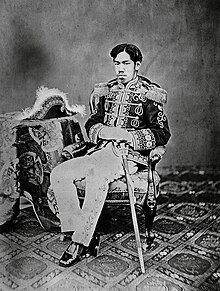
The Meiji Emperor
The Meiji Emperor


According to the oldest Japanese books “Kojiki”, or 古事記, the “Chronicles of Japan”, or 日本書紀, Japanese imperial system began in B.C 660. Following after the first emperor Jimmu, the present emperor is 125th in the history of the imperial family. In Japanese history the position of the emperor has been always changed because of temporary rulers. That is, it cannot be right things to regard emperor as strongest power in this country. This essay will focus on the status of Meiji emperor by comparing with present emperor. In order to examine the difference between Meiji emperor and present emperor, this essay will look over the status of these two emperors and compare these two men.

Firstly, how much power did the Meiji emperor have? According to Sasaki, an emeritus professor at University of Kyoto, Meiji emperor was trained when he was young by Meiji government not to interfere in political march for modernization, the Meiji restoration. This was because the former emperor Koumei, father of Meiji emperor, sometimes showed his political opinion (Sasaki, 2005). Compared with Koumei, the political presence of Meiji emperor was very limited. However, this did not mean he did not do any political activity. Sasaki mentions that the Meiji emperor was used by Meiji government to promote unification for new Japan. It is obvious that Koumei had physical power on Japanese politics even though he had appeared in public just twice, but the portrait of Meiji emperor was widely distributed throughout the country. This is evidence that Meiji emperor was used politically to promote Meiji restoration without having political power.

Secondly, I will discuss the status or position of present emperor. According to the contemporary Japanese constitution article 1, “The Emperor shall be the symbol of the State and of the unity of the People, deriving his position from the will of the people with whom resides sovereign power” (Imperial Household Agency, n.d.). The constitution clearly defines the emperor as a symbol of the State and it also set a restraint of activity for the emperor. In short, similar to the Meiji emperor, the present emperor has no power to remark politically.

Thirdly, let us compare Meiji emperor with present emperor. As this essay has examined in second and third paragraphs, there are some similarities between two emperors. Firstly, both emperors have/ had no power politically. The Meiji emperor had no power to make decisions but he was literally final decision maker. It can be said that Meiji emperor was used just like as a symbol of the new Japan, new government and new country. Secondly, as a symbol of the State both emperors often appear in front of the nation. This emperor’s activity is sometimes used for political reasons, so although the emperor has no political power in present constitution spiritually Japanese people still pay great sense of respect for the emperor.

In conclusion, Japanese emperor has been sort of symbol of the State even in the Meiji era when the constitution defined that the emperor had sovereignty. As a result of that, there are no particular differences between Meiji emperor and present emperor in terms of their being the symbol of the State.

References

Sasaki, S. (2005). Bakumatsu no Tennou・Meiji no Tennou. [The Emperor at the End of Shogunate Government and Meiji Era]. Tokyo: Koudansha.

Imperial Household Agency. (n.d.). Tennou. [The Emperor]. Retrieved July 25, 2013, from Imperial Household Agency web site: http://www.kunaicho.go.jp/about/seido/seido01.html#H2-01

Takeda, T. (2011). Kojiki. [Kojiki]. Tokyo, Gakken.

The Meiji Emperor

By Shu Inoue
The Meiji Emperor
The Meiji Emperor


In Japanese constitution, it said Japanese emperor is a symbol of Japan. Actually present emperor does not have political power and the command of the army. However, in Meiji period emperor had a right to control the country. At that time, the emperor was symbol and leader of Japan.

Firstly, I will write about “Tenno history”. In Japanese myths found in the “Kojiki” and “Nihonshoki”, written in Nara period, two ancient gods Izanami and Izanagi created Japan. They made Japanese islands, ocean and also the many gods. They created a lot of gods from their body. Their tenth-generation descendant ‘Kanyamato-iwarebiko’ (神日本磐余彦) became the Jinmu emperor. The history of the Japanese empire started from him. He is one of the characters in Japanese myth. According to the tradition, he was born in Japanese god’s family and he died when he was 126 years old. He ascended on February 11th, 660 B.C. In Meiji period, the day was defined as National Foundation Day of Japan.

After the Jinmu emperor, the imperial family was Japanese monarch and the actual leaders of Japan. However, samurai influence was on the rise after Kamakura period. They ruled over Japan and finally Tokugawa family unified Japan in Edo period. Real political power passed to the samurai completely.

In 1853, Perry, who was an American sailor visited Uraga, Japan with four worships. Japan was forced to open country. At that time Sonno joi thought (respect emperor and expel foreigners) was spreading in Japan. Especially, the leading members were from Kyushu. They strived to overthrow the Bakufu government led by the Tokugawa family. Finally, in 1867 Bakufu was overthrown, and political power was returned to the imperial family again.

Secondly, in Meiji period, the societal role of Japanese Empire was changed; the emperor became ruler of Japan and created modern Japan.

In 1868, Meiji emperor ascended and Meiji period started. Meiji Tenno was 112nd emperor of Japan. He was born in 1852. His personal name was Mutsuhito. He liked waka poetry (和歌) and left 93,000 poems. In early Meiji period, Japanese government searched new style of Japanese society, so Japanese government deified Meiji Emperor to create new strong Japan that is centering on Meiji Emperor. Also they adopted an idea of Shinto as a form of nation. The idea of Shinto was used in many fields (for example, politics and culture) during Meiji period.

In Meiji period, Meiji emperor was leader of modern Japan and symbol of Japan. Meiji emperor and new government established many modern systems in Japan. In 1882, he set the army as emperor’s army and was head of the army. Before parliamentary system was started, he set a cabinet system, the organization system of cities, towns and villages and a bureaucracy. In 1889, Japanese constitution was published. During China-Japan war and Russia-Japan war he led the war in the field. At that time Japan’s policy was to increase the wealth and military. Japan concluded an alliance with England. Japan aimed to be equal with western countries.

In 1912, Meiji Emperor died of diabetes. He was 59 years old. Meiji Jingu shrine was built to the spirit of Meiji emperor.


Reference

Meiji Jingu. (n.d.). About Meiji Emperor. Retrieved July 24th from http://www.meijijingu.or.jp/about/3-4.html

(n.d.). Japanese myth; Kojiki Retrieved July 24th from
http://www15.plala.or.jp/kojiki/
Hashizume Daisaburo (2013). 世界は宗教で動いている.Kobunsha

Sunday, 4 August 2013

The Meiji Emperor

The Meiji Emperor

(Mutsuhito 睦仁)

(November 3rd 1852- July 30th 1912)


By Konatsu Yasui

The Meiji Emperor
The Meiji Emperor
Do you know the person who changed Japan a lot in the Meiji period? He was the 122nd emperor of Japan, The Meiji Emperor. According to the traditional order of session, he reigned from February 3rd 1867 until his death in July 30th 1912. He succeeded to the throne at the young age of 16 years old. He was the father of modern Japan. He was educated as a normal court noble, however, he had a new point of view and a thought for Japan. Therefore, it is said that he affected to the Meiji period itself. I am going to talk about “The Charter Oath” and his effect on Japan.

In 1868, March 22nd, The Charter Oath, a five important point statement of the new government, was issued. He issued this oath which represented the new country and declared to be a “constitutional country” and did not want Japan to be an autocratic country. He made a solemn promise through the oath with god. Therefore, the oath power was made stronger.

Here is The Charter Oath;

1) Deliberate assemblies shall be widely established and all matters decided by public discussion.

2) All classes, high and low, shall unite in vigorously carrying out the administration of affairs of state.

3) The common people, no less than the civil and military officials, shall each be allowed to pursue his own calling so that there may be no discontent.

4) Evil customs of the past shall be broken off and everything based on the just laws of nature.

5) Knowledge shall be sought throughout the world so as to strengthen the foundations of imperial rule. (Emperor of Japan, 2004)

In this oath, he was represented as a “leader” of Japan, not a dictator. Actually, before the oath was issued he said “If I am lazy emperor, Japan will decline and be reduced to starvation. All responsibility is mine. Therefore, I never forget the fact that all emperors did so far then I govern Japan.” He did not try to change Japan to everything new, but mixed up new and good old customs.

After WWII, the Showa Emperor spoke about the war to Japan then he quoted The Charter Oath. The Showa Emperor must have thought Japanese should remember the Meiji spirit from the oath and rebuild Japan together.

He contributed to develop Japan a lot. In particular, westernization and exchange between Japan and other countries evolved rapidly. At last, Japan was one of powers all around world at the end of Meiji period.

On the other hand, he loved to be western too much. He was often seen wearing Western clothes and riding a horse around Edo. It was one of the effects that led to Japan's modernisation. However, his mind changed after he met a person who is still famous in today’s Japan. The person is Saigo Takamori. He came up to Edo to carry out the abolition of feudal domains and establishment of prefectures, then became an imperial guard. Saigo had a strong belief in “Revere heaven, love people”. This had a strong effect on the Emperor. After that, he reflected on his too strong westernization then he recommended learning “Japanese mind” for each Japanese people. To learn Japanese mind makes us people who can be active all over the world. The thinking is important for today’s Japan too.

The Meiji Emperor had big effect to develop modern Japan. In my opinion, he was the most active and unique emperor ever because his new statements were really different compared with other periods. It worked at this period, but now it does not work well. However, I like his opinion to learn other countries culture which makes our country develop and learn. I introduce his most famous quotation here:
よもの海 みなはらからと思ふ世に など波風のたちさわぐらむ
I wonder why there is trouble, even though all the countries overseas in all directions are considered to be brothers and sisters in this world (Meiji Shrine n.d.)

He really wanted Japan to be a peaceful country. That is why he tried to mix western and Japanese spirit together. He changed Japan a lot and made it one of the most powerful countries in the world. The quotation shows his real mind, “Let’s unite all countries like family” I guess.


<References>

Meiji Shrine. (n.d.). Retrieved July 15, 2013, from http://www.meijijingu.or.jp/index.html

蛭田 亨 [Ebita Toru]. (n.d.). 
Think about Meiji period. Retrieved July 15, 2013, from http://homepage2.nifty.com/kumando/mj/mj030306.html

The Meiji Emperor –Mutshuhito-. (n.d.). Retrieved July 18, 2013 from http://tamutamu2011.kuronowish.com/meijitennou.htm

The things The Meiji emperor left. (2012). Retrieved July 23, 2013 from http://shuchi.php.co.jp/article/1074

西川 誠 [Nishikawa Makoto]. (2011). 天皇の歴史07巻 明治天皇の大日本帝国[The History of Emperor 07 The Meiji emperor and Japan]. Tokyo: 講談社 [Kodan Press]

Keene, D. (2004). Emperor of Japan. Tokyo: 雄松堂書店 [Osyoudo Press]