This project showcases student project work from Japan and the World, a modern Japanese history course offered at Kanda University of International Studies. It focuses on important themes and individuals from the Meiji (1868-1912) and Taisho (1912-26) periods, when Japan was beginning to open to the world after centuries of government-enforced isolation.

All submissions are researched, whether in English or Japanese, and references provided. Comments responding to and exploring ideas, suggesting connections or further reading, are most welcome. As entries are written by non-native English speakers, please refrain from non-constructive comments about language use.

Blog editor/ course designer: Caroline Hutchinson
Showing posts with label ecole des beaux-arts. Show all posts

Sunday, 3 August 2014

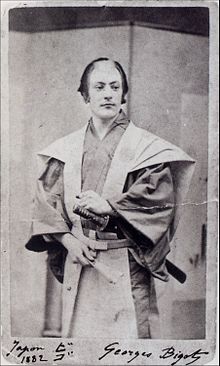
Georges Ferdinand Bigot

Georges Ferdinand Bigot
By Yui Yamamoto

Life of my focus person

Most Japanese people have seen before the picture called “gyou fu no ri (漁夫の利)”. It is one of Bigot’s masterpieces which shows the complicated international situation among Japan, China, Russia and Korea. It is drawn by a famous French cartoonist, Georges Bigot. Bigot was born and raised in Paris and learned at École des Beaux-Arts. After he started working as an illustrator, he was interested in “Japonisme” and decided to come to Japan in 1882. He learned Japanese and lived in Japanese community and frequented red-light districts (yukaku gayoi) to know more about Japan.

Although Bigot is generally known for cartoons in Japan, there are plenty of genre paintings which showed daily life and social conditions faithfully at Meiji period. For example, in a drawing of voting, there are many Japanese men in Western clothes who have Western hairstyles or mustaches. It showed that only high-class men had voting rights and participated in political events. The most significant point of this picture is a man who is wearing Kimono and has a Japanese topknot. His style is really rare in that situation, as can be seen from other men. A cartoon magazine produced and released by Bigot, called “TÔBAÉ”, was published for foreign residents in 1887. It was organized his critics such as the Japanese government. At present, those works are really important historical materials.


Summary of discussion

Q1. What do you think / how do you feel about his drawings?

Q2. Imagine if you were Bigot, what would you draw about present Japan?

Initially, listeners were impressed by the works especially cartoons for the first question. They had same opinions as mine that the pictures explained as they are. I thought that they have already known his works so it was easy to think. Although the second question was a little bit tricky for them, we could share some ideas at the end of the discussion. Most of them talked about Japanese problems such as Fukushima problems, the relationships between Japan and the U.S. and so on. On the other hand, only few ideas about our present daily lives were shared. I thought that it was not easy for us to see ourselves as others see us.


Reflection on person and project

Through this project, I learned that Bigot had really critical eyes. At first, I did not know that he drew various works as well as cartoons. For example, there are “Japanese” who he admired in his genre pictures. Also, they showed real daily lives in Meiji period. Therefore, I realized again how he saw Japan clearly, calmly and carefully. I am surprised that we are in the same situation of his works. In fact, there are plenty of types of media and they are playing a major role in the sharing of information. However, the government is still strict about them even though Japanese people want to know the truth. I think the picture shows us that it is significant to have various “eyes” on your mind.


References

Shimizu, Isao. 2001. Bigot ga mita Nihonjin. Tokyo: Kodansha

Shimizu, Isao. 2006. Bigot ga mita Meiji Nppon. Tokyo: Kodansha

Tuesday, 4 February 2014

Georges Ferdinand Bigot

By Hikari Kozono

Background

Have you ever heard of a non-Japanese painter who drew not only luxury life of Japanese upper class but also ordinary life of masses? Georges Ferdinand Bigot was the French painter who depicted Japan in Meiji period. He really liked beauty of Japan and Japanese people. He was born in France in 1860. His mother encouraged him into art. At the age of twelve, he was accepted by the École des Beaux-Arts in Paris, where he was trained by artists such as Jean-Léon Gérôme and Carolus-Duran. He was interested in Japonism and Japanese art by number of collectors of Japanese art in school and he decided to work as an illustrator of newspaper to pay for the trip to Japan. 

He came to Japan at the beginning of the Meiji-era to study Japanese and Japanese art. After that he worked at the imperial Japanese army academy where he taught water color paintings to his students as an Oyatoi Gaikokuzin [Editor's note: a non-Japanese person employed by the Japanese government to teach necessary skills for Japan's modernisation] for 2 years. After he was done with his teaching job, he was allowed to stay in Japan by drawing pictures for French people in Japan. Eventually, his works became popular among those who were interested in Japanese life and against revision of treaty. His main customers were French people who lived in the foreign settlement Japan. However many of them were opposed to revision of treaty and went back to their home countries. That made Bigot worried about losing a lot of his customers. He also worked as a journalist by drawing scenes he saw but since photo technology developed at this time, his work gradually decreased. He thought it would be difficult to publish magazines freely in Japan and decided to go back to France. Before he went back to France, he divorced to his Japanese wife Masu Sano. In France he kept working as a painter for some French magazines and newspapers. He died in 1927 while he was walking in the Japanese style garden in his house.

Satirical cartoon

Although his first interest in Japanese art was Japonism, his main style of painting was satirical cartoons. Satire means to use humor to show how foolish some people’s behavior or ideas are. He mostly illustrated scenes of everyday Japanese life of masses and upper class but also ridiculed Japanese politicians, revision of treaty, and what he felt to be too much westernization in Japan in his famous satirical newspaper, Tobae. He published it for French people who lived in Japan but he put Japanese captions on his works in order to impress Japanese journalists, and sent them to Japanese newspaper publishing companies. He watched Japan’s rapid westernization with a mixture of curiosity and affection, producing a lot of pictures of the scenes he saw and tried to introduce these to the West.

Affection for Japan

While Bigot criticized too much westernization in Japan, he loved and respected Japanese tradition, culture and the everyday life of ordinary people. He especially expressed affection towards Japanese woman who are calm and obedient to men. In Tobae, he wrote “The best thing in Japan is women. Japanese women should keep being Japanese.” It is said that Bigot saw Japanese women as symbol of Japanese tradition. The picture below is the one of his satirical cartoons about westernized Japanese called “Rokumeikan’s lady”. He depicted westernized upper class Japanese women smoking in the dance hall as looking like monkeys. 


Bigot could draw pictures from the same point of view to Japanese masses. That is because he assimilated into Japanese masses easily by living outside of foreign settlement and carefully observing Japanese ordinary life. He drew various looking Japanese unlike many painters who drew only Japanese people with glasses, slant eyes and buck teeth. I guess that would change the image of Japan for those foreigners who knew only stereotype of Japanese. Some of his work didn’t receive good evaluations because he drew too ordinary scenes. However, he definitely played an important role in telling people about real Japanese life. I think his drawings will be great resources to tell people life of Japanese masses and upper class in Meiji era.


References

Simizu, I. (December 8, 2006). Bigo ga Mita Meiji Nippon. Tokyo: Ko-dan sha

Georges Ferdinand Bigot. (December 9, 2013). Retrieved on January 23, 2014. From Wikipedia: http://en.wikipedia.org/wiki/Georges_Ferdinand_Bigot