This project showcases student project work from Japan and the World, a modern Japanese history course offered at Kanda University of International Studies. It focuses on important themes and individuals from the Meiji (1868-1912) and Taisho (1912-26) periods, when Japan was beginning to open to the world after centuries of government-enforced isolation.

All submissions are researched, whether in English or Japanese, and references provided. Comments responding to and exploring ideas, suggesting connections or further reading, are most welcome. As entries are written by non-native English speakers, please refrain from non-constructive comments about language use.

Blog editor/ course designer: Caroline Hutchinson
Showing posts with label myth. Show all posts

Monday, 5 August 2013

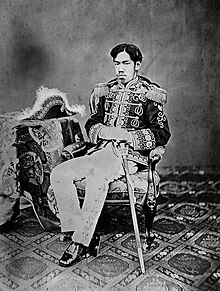
The Meiji Emperor

By Shu Inoue
The Meiji Emperor
The Meiji Emperor


In Japanese constitution, it said Japanese emperor is a symbol of Japan. Actually present emperor does not have political power and the command of the army. However, in Meiji period emperor had a right to control the country. At that time, the emperor was symbol and leader of Japan.

Firstly, I will write about “Tenno history”. In Japanese myths found in the “Kojiki” and “Nihonshoki”, written in Nara period, two ancient gods Izanami and Izanagi created Japan. They made Japanese islands, ocean and also the many gods. They created a lot of gods from their body. Their tenth-generation descendant ‘Kanyamato-iwarebiko’ (神日本磐余彦) became the Jinmu emperor. The history of the Japanese empire started from him. He is one of the characters in Japanese myth. According to the tradition, he was born in Japanese god’s family and he died when he was 126 years old. He ascended on February 11th, 660 B.C. In Meiji period, the day was defined as National Foundation Day of Japan.

After the Jinmu emperor, the imperial family was Japanese monarch and the actual leaders of Japan. However, samurai influence was on the rise after Kamakura period. They ruled over Japan and finally Tokugawa family unified Japan in Edo period. Real political power passed to the samurai completely.

In 1853, Perry, who was an American sailor visited Uraga, Japan with four worships. Japan was forced to open country. At that time Sonno joi thought (respect emperor and expel foreigners) was spreading in Japan. Especially, the leading members were from Kyushu. They strived to overthrow the Bakufu government led by the Tokugawa family. Finally, in 1867 Bakufu was overthrown, and political power was returned to the imperial family again.

Secondly, in Meiji period, the societal role of Japanese Empire was changed; the emperor became ruler of Japan and created modern Japan.

In 1868, Meiji emperor ascended and Meiji period started. Meiji Tenno was 112nd emperor of Japan. He was born in 1852. His personal name was Mutsuhito. He liked waka poetry (和歌) and left 93,000 poems. In early Meiji period, Japanese government searched new style of Japanese society, so Japanese government deified Meiji Emperor to create new strong Japan that is centering on Meiji Emperor. Also they adopted an idea of Shinto as a form of nation. The idea of Shinto was used in many fields (for example, politics and culture) during Meiji period.

In Meiji period, Meiji emperor was leader of modern Japan and symbol of Japan. Meiji emperor and new government established many modern systems in Japan. In 1882, he set the army as emperor’s army and was head of the army. Before parliamentary system was started, he set a cabinet system, the organization system of cities, towns and villages and a bureaucracy. In 1889, Japanese constitution was published. During China-Japan war and Russia-Japan war he led the war in the field. At that time Japan’s policy was to increase the wealth and military. Japan concluded an alliance with England. Japan aimed to be equal with western countries.

In 1912, Meiji Emperor died of diabetes. He was 59 years old. Meiji Jingu shrine was built to the spirit of Meiji emperor.


Reference

Meiji Jingu. (n.d.). About Meiji Emperor. Retrieved July 24th from http://www.meijijingu.or.jp/about/3-4.html

(n.d.). Japanese myth; Kojiki Retrieved July 24th from
http://www15.plala.or.jp/kojiki/
Hashizume Daisaburo (2013). 世界は宗教で動いている.Kobunsha

Friday, 2 August 2013

Lafcadio Hearn: His Journey Through Japan

Lafcadio Hearn
Lafcadio Hearn
By Ayako Miki

Lafcadio Hearn, later known as Koizumi Yakumo, is definitely one of the most important non-Japanese in Japanese history, who wrote more than ten books about Japan which showed old Japanese way of life through a Westerner’s eye from ancient myth to people’s daily lives. He is often described as a naturalized Japanese who researched and grasped what is called “Japanese mind” and this is the reason why he was counted as such an important person in history. However, his perspective toward Japan changed significantly thorough his fourteen years in Japan. The aim of this paper is to clarify how Hearn’s perspective on Japan changed by examining his writings and historical facts.

In his early days in Japan, Hearn seemed to see the country very delightedly with great enthusiasm. According to My First Day in the Orient[1], he found this Far East as “the old and new mingle so well” and described Japanese as “the most lovable people in the universe”. Considering adjectives used in the essay which are “divine” “fantastic” “beautiful” “mysterious” etc, it was clear that he found almost everything very attractive and exotic. Although he was surrounded by unfamiliar, strange, unknown things, he enjoyed himself being stranger on the street. Also, another reason for him to find Japan exotic and mysterious was that he spent his first two years in Matsue. Shortly after landing, Hearn was sent to Matsue in Shimane prefecture to teach English by Japanese government. Shimane prefecture is known as the place where many Japanese myths were set, which interested him. With this enthusiasm brought by the honeymoon days and encounters with the ethnic ancient tales, Hearn mostly saw Japan as a beautiful, warm, friendly nation.

However, after moving to Kumamoto from Matsue where he spent his first year in Japan, Hearn seemed to realize that his beloved Japan was standing at a turning point which disappointed him. Although it was far apart from Tokyo, Kumamoto city was big enough to reflect the influence of Meiji Restoration. He criticized the transition as “rapid industrialization took away Japanese traditional minds from people”[2]. Compared to Matsue, small city but still possessing fragments of Japanese mythology everywhere, Kumamoto was much more modernized and leaving traditional Japan behind. Because of the bigger population and urbanness of Kumamoto, also feeling huge changes happening to Japanese society in Meiji Era, Hearn left for Kobe to be a journalist at a newspaper company for foreign residents in Japan by quitting his job as an English teacher. It did not take long for Hearn to notice the transition of Japan, which disappointed him. He could not help feeling his love melting away.

Finally in his later days, moving to Tokyo, Hearn begun to note his melancholy and nostalgia for Japan which he dreamt of. “The beautiful illusion of Japan, the almost weird charm that comes with one's first entrance into her magical atmosphere, had, indeed, stayed with me very long,” he wrote in his essay titled In Yokohama[3], “but had totally faded out at last.” He mourned for his passing days filled with divine specters, sweetness, traditional Japan and people who possessed loving hearts. However, during his very last time in Japan, he did not mention that his memory and dream were lost because of rapid social change known as Meiji Restoration. In contrast to writings from days in Kumamoto, he gradually came to notice that he got used to his Japanese life as if he had awakened from a dream. Although his writings in Kumamoto seemed to contain anger and criticism for Meiji Restoration, at this time he started to express his disappointment to himself and more nostalgia for the illusion of Japan which captured and led him to this far-east Orient from the United States. At last his dream was lost, and Hearn was certainly aware of that. Shortly before his death, he continued to note his indescribable love and melancholy for lost Japan and passing days.

Hearn is now often described as a person who loved Japan without any doubts. However, as his writings telling us, his mind changed through his fourteen-year life in Japan. At first it was only enthusiastic, but gradually vivid colors were washed out by Westernization, and finally he noticed the Japan that he dreamt of was lost because of both of Meiji Restoration and changes happened to himself. His life, of course his mind, too, was not as easy as recent people expected. However surely he was in love with Japan, which he once regarded as his home. He passed away fifteen years after his first day of Japan, and now he rests in the Zosigaya grave. He ended his life in the place he dreamt of; even though it disappointed him, perhaps he reached the Orient heaven at last.

Citations 

[1] Hearn, L. (n,d,). Lafcadio Hearn – The First Day in the Orient. Retrieved from http://www.oldandsold.com/articles33n/essays-studies-25.shtml

[2] Hearn, L. (n,d,). Insect Musicians. [Mushi no Ensoka]. Tokyo. Kodansha.

[3] Hearn, L. (n,d,). In Yokohama. Retrieved from http://lafcadiohearn.jp/articles/InYokohama.html
References

Hearn, L. (1990.). Glimpse of Unfamiliar Japan. [Shirarezaru Nihon no Omokage]. Tokyo. Kodansha.

Hearn, L. (1990.). Kokoro. Tokyo. Kodansha.

Yamada, T. (2002). Glimpse of Japan- The world of Lafcadio Hearn. [Nihon no Omokage – Lafcadio Hearn no Sekai.]. Tokyo. Iwanami Gendai Bunko.