 |
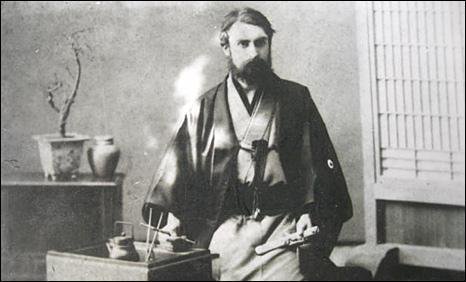
| William Kinnimond Burton |
Summary about my focus person
Today, we, Japanese can get clean and safe water from taps, and Japan is proud of their high quality water system. We may think it is natural thing but let’s think about the past time. Until the Meiji period, Japan’s water system was in bad condition and Japan was suffered from several serious diseases, especially cholera. This is a disease that can lead to rapid dehydration and electrolyte imbalance and death in some cases. So, Meiji government decided to invite a sanitary engineer, William Kinnimond Burton from Scotland. He worked at Tokyo Imperial University as an unofficial professor to teach sanitary engineering and developed some superior engineers. Also, he had an important role in health office at Department of the Interior to build a base of Japan’s water system. These bases are the origin of today’s public health engineering or environment engineering. We can say that he is a great person who made Japan’s water system.
Furthermore, Burton had another achievement. He was active as a photographer. His grandfather was a famous photographer in his hometown. Because of his grandfather’s hobby, Burton also had a detailed knowledge of photography. So, he used his knowledge and his skills to take photos of Japan’s various scenes. He took the photos of beautiful views such as scenes of Hakone or Mt. Fuji, Japanese costumes or daily life of Meiji period. Not only did he take pictures of these usual things, but also many photos of times when Japan was attacked by some disasters. For example, in 1891, the great earthquake called Noubi-Jishin (濃尾地震) occurred in Gifu prefecture. This disaster was really massive, and it destroyed many buildings that were built in Meiji period, so Japanese government set up the institution to research the situation after earthquake struck. Burton joined the institution and left a lot of photos.
Summary about my discussion
I prepared some discussion questions, and they were “Do you think he had done great work for Japan? Which part?”, “What kind of historical photos would you like to see?” and “If you could go to Meiji period, what kind of photos would you take?” In the first discussion question, “Do you think he had done great work for Japan? Which part?” we all agreed he had contributed to Japan a lot. The reason is he made the base of Japan’s water system and brought clean and safe water to Japan. Then, for the second question, “What kind of historical photos would you like to see?” one of us answered they want to see the photo of lower-class daily life because they would like to see another aspect of Japan. In the final question, “If you could go to Meiji period, what kind of photo would you take?” a member said that she would want to take a photo of the countryside's situation because she has seen only the scenes of developed and modernized Japan.
Reflection
When I look back on my presentation, I have some reflections. First, I didn't prepare some detailed slides, so it was little hard for my audiences to understand deeply. Also, I needed to learn more about Burton. When the audience asked me some questions about him, I couldn't say the right answers because my preparation was not enough. Finally, I didn't make so much eye contact because I’m shy. But, when I give a presentation, it is important thing to attract my audiences and to check the audiences’ understanding. So, having these reflections, I noticed that I should have more detailed slides to give more clear information for my audiences and I need to research more about my focus person to answer the questions from other students. Also, I have to make eye contact with my audiences. I hope I will be able to make presentation better with these reflections.
Reference
Japan Association of Drainage Environment (2006,1,1). The activity related with W.K. Burton. http://www.jca.apc.org/jade/barton/ba150.htm
Wikipedia(2014,5,13). William Kinnimond Burton. http://en.wikipedia.org/wiki/William_Kinnimond_Burton
Jearr MarieMahieu (2004). The great earthquake in Japan. http://www.npobook.join-us.jp/report.vol_31/index.html

