 |
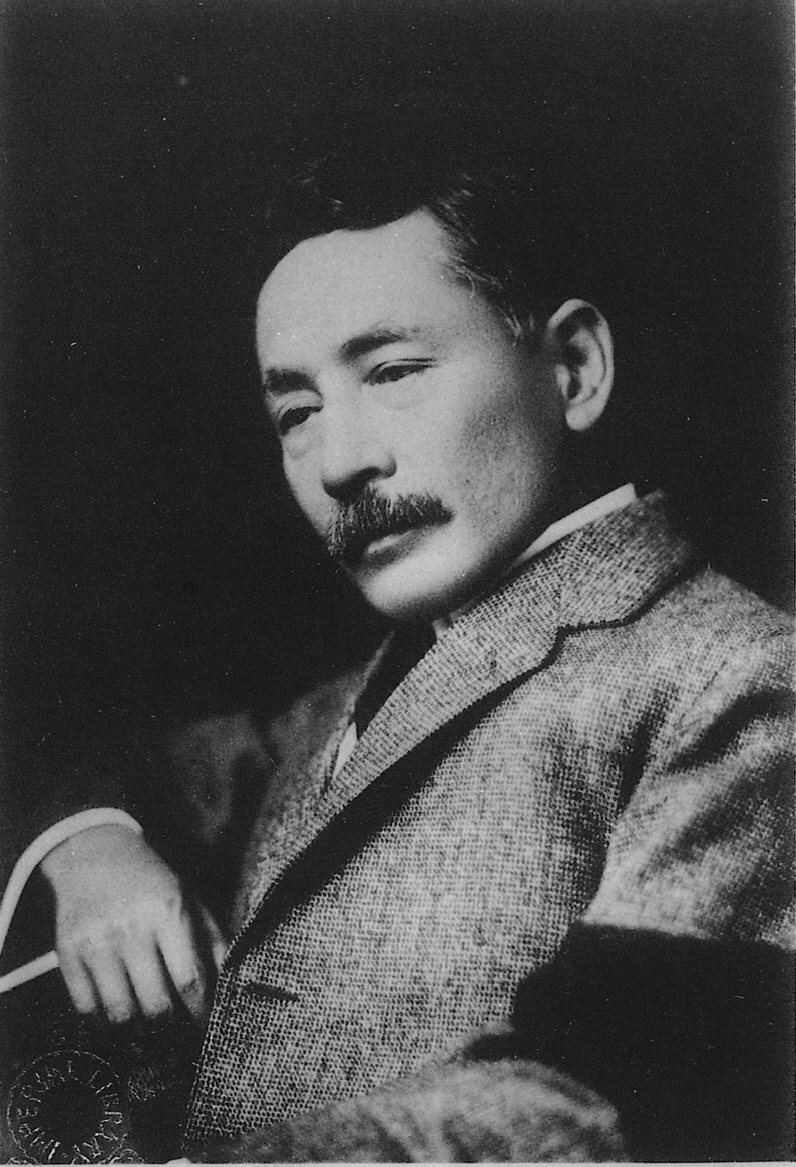
| Natsume Soseki |
I would like to present Natsume Soseki’s growth, experience and the effect on his character, and his contribution to society at that time and this time. The reason why I chose him is I was interested in his literature when I was junior high school student. I would like to know his personal side. I think his personal background and experience must have influenced his works, and have given a lot of ideas to his works. That is why I chose him.
Firstly, I will mention three main points about Soseki’s growth: his family, study in Japan, and study in Britain.
Soseki was born in 1867. At that time, Japan was full of upheavals. The Meiji Restoration [Editor’s note: defeat of the Shogunate and restoration of rule by the Emperor] had happened, and Sakamoto Ryouma and Nakaoka Tarou had been killed by Bakufu [the ruling Shogunate]. His father was a village head, so Soseki’s parents’ home was rich. His mother had many children. He had four brothers and three sisters. However, Soseki was not a wanted child. His parents’ treatment of him was terrible. His parents had never treated him as their child. Soseki was born in rich family, but not an amiable family. He was sent to a merchant family by his father as soon as his birth. Unfortunately, his adoptive father and his father had a trouble, so he went back to his house where he was born. The trouble between them continued until Soseki entered ASAHI press when he was 40 years old. That experience, and his domestic environment, gave him the ideas for “Michikusa”.
He acquired culture at ten different schools and Universities. He changed his learning place many times. He mainly learned English literature, because he was really interested in English. When he entered Nishyougakushya University, he learned ethics, the western sense of beauty, and Edo’s sensitivity. He had an outstanding brain, so he was the head of his class in all subjects especially English. He became an honor student of Tokyo University. As a result of his outstanding work, he got job from his professor to translate “Houjyouki” (Kamakura era masterpiece). He met Masaoka Shiki at Tokyo University, and they became best friends and haiku companions.
Governor let Soseki to study in Britain. Soseki was inspired by European thoughts, education, and their way of living. Also he could concentrate on his study of English literature. “MY INDIVIDUALISM” was inspired by their ideas of “Freedom”. British freedom meant one had to have the responsibility to be free. However, Japanese freedom was totally different. Through his studying in British, he found that an ideal English teacher is a person who has studied overseas then mastered English as a communication tool. Furthermore, he got many ideas about educational style.
Secondly, I will mention his experiences and the essential points to build up his character. I will focus on the literature, his friends, and illness.
He loved not only writing but also reading. He is famous for loving foreigner’s literature. When he went abroad to Britain, he read Jane Austen’s literature with pleasure. It is not an exaggeration to say that his literature was influenced by her works.
He had a lot of precious friends. When he was 22 years old he met Masaoka Shiki at Tokyo University. Soseki was impressed by Masaoka’s haiku and became his haiku companion. They improved each other so that Masaoka is necessary for Soseki’s works and Masaoka was too. Thanks to Shiki’s friend Takahama kyoshi (literature companion), Soseki became a full time writer. Soseki had neurasthenia (a nervous breakdown) so Kyoshi believed that if Soseki focused on his works, he would be able to forget his uneasiness. He had not only literature companions; he also had friends for boat race, and gymnastics. He was really interested in boat race and good at gymnastics. He had good relationships with them.
Soseki had really poor health. He had serious illnesses more than fifteen times. He suffered from illness from only three years old to when he died. His one-year-old fifth daughter died when he was forty-four years old. Her cause of death was uncertain, because of that, Soseki decided to ask his doctor to examine his body by dissection after his death.
Lastly, I will mention his contribution to Japanese society at that time and this time, focusing on his works, his educational style, and his famous speech at Gakushuuin University.
He produced about 37 masterpieces in his short life. His works give his reader great impact even now. “KOKORO” is really meaningful novel because depending on the age, each generation feel differently. That is why it is difficult to understand his works. Its psychological description lets reader consider deeply. The time background is of course different from these days, however the characteristics are related to us. ASAHI press took a survey to ask audience which writer is the best writer in Japan of the past thousand years. The most popular writer was Natsume Soseki.
Soseki taught mainly English at about six different Universities, junior and high schools such as Meiji, Tokyo, and Waseda University. Soseki carefully considered not only his teaching style but also how to build up students’ character. His teaching style was incredible, because he had already found that to unite grammar and communication is the best way to learn English. That idea had just started in 2013. I was so surprised to know that. His educational style was very practical, because he thought English was a tool to communicate, not for study.
“MY INDIVIDUALISM” was a speech given by Soseki at Gakushuuin University. When I read it, I was so impressed, because he noticed that Japanese society’s fault even though it was 1914. His quote must have influenced many people even now. He told the students three main topics. Firstly, “If you want to be free, you have to accept other’s freedom.” Secondly, “If you want to use your right, you have to have its duty.” Lastly, “If you want to use your power of money, you have to think about its responsibility.” After he left such meaningful speech, he passed away when he was 49 years old.
In conclusion, I have mentioned Soseki’s growth, experiences, and contribution. I noticed that he had a lot of setbacks. Through his difficulties, he made lots of outstanding and meaningful works. I think his setbacks are his works’ essential items. He had to have serious illness. However, the motivation to produce his works was his limited life I think. In learning about his background, Soseki taught me fortitude. Even we have difficulties, we should overcome our difficulties and should not give up.
References
Kimura. (1998). Natsume Soseki’s history. Retrieved May 5, 1998, from Biglobe web site: http://www2a.biglobe.ne.jp/~kimura/senpu.html
Koki, K. (2000). Natsume Soseki as English teacher. Japan: Shintyosya Institution Press.
Mizuho, I. (2004). Soseki in London. Japan: Seibundou Institution Press.
Soseki, N. (1978). MY INDIVISUARISUM. Japan: Kodansha Institution Press.

