This project showcases student project work from Japan and the World, a modern Japanese history course offered at Kanda University of International Studies. It focuses on important themes and individuals from the Meiji (1868-1912) and Taisho (1912-26) periods, when Japan was beginning to open to the world after centuries of government-enforced isolation.

All submissions are researched, whether in English or Japanese, and references provided. Comments responding to and exploring ideas, suggesting connections or further reading, are most welcome. As entries are written by non-native English speakers, please refrain from non-constructive comments about language use.

Blog editor/ course designer: Caroline Hutchinson
Showing posts with label matsuyama. Show all posts

Tuesday, 4 February 2014

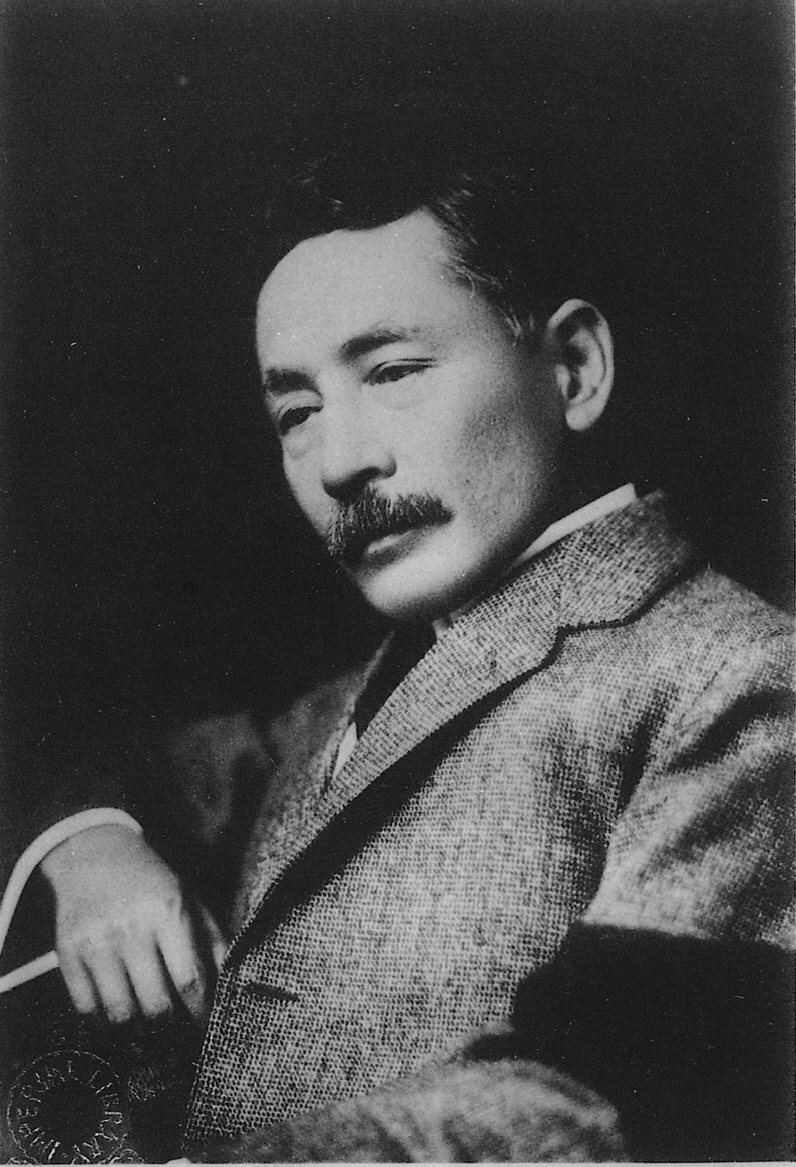
Natsume Soseki

Natsume Soseki
By Seina Suzuki

Soseki was the sixth child and unwanted child by his family, because he was born to his mother late in her life. His mother was 40 years old and father was 53 years old. In 1868, he was sent to childless couple named Shiobara Masanosuke and his wife. However they divorced, therefore Soseki returned to his real family when he was 9 years old. His family welcomed him, except for his father. He didn’t have good relationship with his father. His mother died when he was 14 years old.

He attended the First Tokyo Middle school (now Hibiya High School) and while studying there, he became enamored with Chinese literature and he dreamed of becoming a writer. When he told his old brother about his dream, his family strongly disagreed. In 1884, he entered Tokyo Imperial University to become an architect. While at university, he study Chinese classics and also started to learn English.

In 1887, he met Masaoka Shiki and Soseki was affected by him. Soseki started singing his poems. He entered English Literature department in 1890. In 1895, he began teaching at Matsuyama Middle School and he also published haiku and Chinese poetry in that time.

In 1900, he was sent to study in Great Britain as “Japan’s first Japanese English literary scholar” by the Japanese government. However he didn’t get his scholarship by government. He studied instead at University College London. Before he arrived in London, it took 2 months to get there. He visited many museums in London. He studied a lot of English and he came to have a fundamental question, “What is Literature?” He wrote “Theory of Literature.” He had to go back to Japan before he could accomplish his ambitions. He didn’t enjoy his life in London however he learned some things and wrote “Theory of Literature”.

Soseki’s literary career started in 1903. He published his haiku in some magazines. He won public admiration when he published “I Am a Cat”. His first major work was that novel. “I am a Cat” was written from the viewpoint of a cat and Soseki also a cat. The owner of the pet Mr. Kushami is a self-ironic portrait of the writer. He succeeded and published many novels like Botchan, Tower of London in 1905, and Kusamakura in 1906. His post when he wrote at the university got a position with Asahi Shimbun and he began writing full time. In that time, Naturalist literature was popular; however he was part of Yoyu-function.

In 1907, he decided to resign from his teaching job and entered a newspaper company The Asahi Shimbun as a novelist. He wrote a lot of stories in newspaper. His novels were full of humor at the first, but later changed to focus on depth of human psychology, isolation and egoism, and analyzed the contradictions in Japanese society.

He died of stomach ulcer on December 9th 1916. He was writing “Light and Darkness”, however he didn’t finish writing about it. His novels are still widely read and his major works of fiction have been translated into English.


Reference list

-Natsume Soseki, the greatest Novelist in Modern Japan
http://www.ucl.ac.uk/library/exhibitions/soseki-pamphlet.pdf#search='natsume+soseki'

-Wikipedia Natsume Soseki

-Natsume Soseki
http://www.kirjasto.sci.fi/natsume.htm


Friday, 2 August 2013

Natsume Soseki

Natsume Soseki
Natsume Soseki
By Ayaka Ohara

Natsume Soseki is one of the famous people who lived in Meiji period. He was a novelist, critic and a scholar of English literature. He made a lot of works which connect to loneliness, for he had a lonely childhood. Also he studied in the UK and played a role in translation. Natsume Soseki was a talented person, and still influences society now. I was interested in his unique personality resulting from his lonely experiences, so I will introduce Natsume Soseki through his novel Bocchan and his famous translation.

“Loneliness” is the key of Soseki’s works. The loneliness came from his childhood experiences, inferiority in himself and opposition to modernization. One of his famous novels, “Bocchan”, reflects Soseki himself, and both Soseki and Bocchan have similarities. There are two sadnesses in the story, “Bocchan”.

Soseki was sent to another family as a foster child soon after birth, and he was adopted when he was 1 year old. Although he returned to his real family when he was 9 years old, his real mother died when he was 14 years old. Bocchan was deserted by his mother 3 days before she died. Also he was not loved by his father. He and his brother were not in good terms, and he had never met his brother since his brother went to Kyushu for work. Soseki and Bocchan have the same loneliness against family, which is one sadness.

The similarity is not only childhood but also the whole story ― Bocchan went to Matsuyama as a teacher, and he faced some difficulties there. From the middle of the story, he does not trust “Aka shatsu (red shirt)” and “Nodaiko” who are intelligent. One day he felt discomfort against society. He lost Aka shatsu and Nodaiko and left Matuyama. ― Matsuyama is the symbol of modern Japan, and he felt uncomfortable there. “Aka shatsu” is Natume Soseki. Both of them are scholars who graduated from a department of literature. By drawing himself critically as the symbol of modernization in the novel, he also criticized modern Japan. In the end, he left modern Japan. As a result, he lost modern Japan, which is another sadness.

There is a nice sentence which Soseki translated which is favored among fashionable or intelligent people. When he was a teacher, one day in his class, he translated “I love you” into “Tsuki ga Kirei desune” which normally means “The moon is beautiful” after he heard a student translate “I love you” literally into “Ware Kimi wo Aisu”. He said it was enough to communicate your feeling because he was a person in Meiji period when feeling (Jou) was common rather than love (Ai). That is why he thought the direct sentence “Ware Kimi wo Aisu” was not practical and did not meet Japanese sensibility, so he regarded it as better to communicate with Japanese lyrical way which connects with former sentence. It is very natural that he translated this way because he was very smart and he did not like unfashionable things. The reason why he translated into such a nice sentence is that his experiences were different from others, which gave him unique ideas. The sentence “Tsuki ga Kirei desune” (The moon is beautiful) is often used to communicate love by today’s people. They favor the sentence because it is like a kind of secret sign and they think it is more tasteful than using “Ai shiteru” directly.

Natsume Soseki was a representative person in Meiji period. Nobody doubts he was an educated and intelligent person in modern Japan. He is a famous person, but he was a lonely person. He influenced society with his study and sensibility. He contributed to society for giving new idea. However he was negative about modernization and himself. The negative thought made his works interesting. All his experiences helped him to get unique idea and good sense. Even his lonely childhood was not unnecessary.


References

Anonymous. (January 15, 2012), 夏目漱石『坊っちゃん』は自己批判の書ではないか?(再掲).のび日記~誤読と曲解の日々~. Retrieved July 14, 2013, from http://d.hatena.ne.jp/nobitter73/20120115/p2

Anonymous. (October 17, 2007), 「i love you 」=「月が綺麗ですね」 . Retrieved July 14, 2013, from http://detail.chiebukuro.yahoo.co.jp/qa/question_detail/q1313126873