This project showcases student project work from Japan and the World, a modern Japanese history course offered at Kanda University of International Studies. It focuses on important themes and individuals from the Meiji (1868-1912) and Taisho (1912-26) periods, when Japan was beginning to open to the world after centuries of government-enforced isolation.

All submissions are researched, whether in English or Japanese, and references provided. Comments responding to and exploring ideas, suggesting connections or further reading, are most welcome. As entries are written by non-native English speakers, please refrain from non-constructive comments about language use.

Blog editor/ course designer: Caroline Hutchinson
Showing posts with label ito hirobumi. Show all posts

Saturday, 2 August 2014

Edmund Morel

Edmund Morel
By Takahiro Sakaguchi

Edmund Morel was the memorable British man in Japan. In 1840 he was born in London. He studied applied chemistry and became the civil engineer taught by Mr. Clerk who was the master of the civil engineer. In 1870, he was invited by Japanese government to establish the railway in Japan. He was famous as the first foreign engineer in Japan. In that time only Ookuma Shigenobu and Ito Hirobumi supported his work, but his effort for making the railway impressed Japanese engineers. Also, he invited Japanese engineers to his house to teach them how to construct the railway. Unfortunately, he fell sick and died while the railway was not complete. In 1872, the railroad between Yokohama to Shinagawa was opened. This was Japan’s first railway. After using the train, Japan developed innovatively and speedily. Nowadays, more than 80% of Japanese people use train in a day.

My three discussion questions were “How would you feel if you saw the train for the first time? ”, “What country would you want to go if you had the knowledge of train engineer? ” and “What would you think if there was no train in Japan?”. First question was easily answered - that it makes us surprised and excited - because my classmates think it was the innovation of Japanese society and economy. For the second question, most classmates thought Asian countries because they thought Asian countries had not developed and there were no trains when Morel came to Japan. For the third question they answered that it might be hard to commute to KUIS [our university – Ed] and it would take a lot of time to arrive somewhere we wanted to go.

I feel that through the presentation and discussion it can be understood that history is connected to our current life. If Edmund hadn't come to Japan, Japan would not have been developed like the comfortable life. Unfortunately, some presentations were a little bit hard to understand. The person who has the presentation needs to take care of the classmates and how to understand it for every classmate equally. It makes the discussion better. Also, making discussion question is sometimes difficult for me because other students didn’t understand discussion question even I made a nice discussion question. It made me frustrated.

Finally, Morel made Japan develop more speedily and innovatively by making the railway. Time is changing, skill also is changing.

Reference

Edmund Morel, Yokohama Association for International communications and Exchanges, 1999, regards from http://www.city.yokohama.jp/me/yoke/theyoke/no.91/morel.html

Tuesday, 4 February 2014

Ito Hirobumi

By Yasuda Minori
Ito Hirobumi

In Japan, the first Prime Minister was a man who was born as a low class samurai, and the man is Ito Hirobumi. I presented about him in the class before, but I’m still interested in him. The reason why I think he is interesting is because he lived from Edo period to Meiji period. The lifestyle had changed a lot comparing both eras, but he adapted to it, and also he became one of the people who changed Japan at that time. Therefore I’d love to focus on what he did in his life.

Ito Hirobumi was born in 1841 and named Risuke at first. His family was very poor, and his father was a common foot soldier, so his father was adopted to help their family budget. Since they were adopted by Mr. Ito, who was a member of Choshu domain, the family changed their last name from Hayashi to Ito. At the same time, Risuke also changed his name to Hirobumi.

When he was 16 years old, after the arrival of Perry, who tried to push Japan open the country, Hirobumi began to work as a member of Uraga security because Japan’s feudal government ordered Choshu domain to do so, and his boss was Kurihara Ryozo. He introduced Yoshida Shoin’s cram school to Hirobumi, and he worked for the principle of advocating reverence for the Emperor and the expulsion of foreigners with Katsura Kogoro and Takasugi Shinsaku. Hirobumi was influenced by Shoin a lot, but after his trip to England in 1863, he changed his thought to be in favour of opening the country and overthrowing the government.

Ito Hirobumi was thought to be the great person in Japanese history and you may think in the same way. However, he is also known as an emboldened young man joined to the movement of overthrowing a government. One of the most well-known cases he was involved in was attacking with fire the England legation being built in Shinagawa in 1863. In those days, he was still a teenager of low birth. In addition to this, Mr. Ito is said to have assassinated a waka poet, Kato Kojiro, and the fourth son of a Japanese classical scholar, Hanawa Hokiichi.

As seen above, it seems that Ito Hirobumi would be called a terrorist if he was alive now because his movement was too revolutionary, but he certainly did the very important job for Japan. And one of the biggest jobs is making Meiji Constitution. Ito left Japan in March 14, 1882 to search the constitutions in foreign countries. Additionally, he searched about imperial courts, parliaments, the Cabinets, laws, and local government systems. His studied them in Germany, Austria, Britain, and Belgium, and his visit to Europe lasted for a year and 2 months.

His actions should be seen as dangerous and strange. He was assassinated in Korea because he was the leader of Japan which had occupied and invaded Korea. These days, I heard about the news that a memorial hall was being built for the man who killed Ito, An Jung-geun. In Korea, he is thought to be a hero, but in Japan, he was just a killer. So Japanese governors said that building the memorial hall made them angry because An Jung-geun was a criminal. Responding to these comments, Korean governor got angry. However, for me, neither side should care about such actions or comments. That’s because the hero of a battle between two groups must be a criminal or an enemy for the other group, a loser. The most important thing here is how a movement a person did has influenced and changed one country. Thinking of that helps people not to be angry and to look back on a part of their history.


References

(2010). そのとき伊藤博文は、どうしたか. Retrieved January 14, 2014, from J-Net21: http://j-net21.smrj.go.jp/watch/sanpo/entry/20100712.html

(2010). 伊藤博文. Retrieved January 14, 2014, from 日本歴史巡り: http://www.jphistoryrd.com/mei/ito.html

(2013). 日韓、今度は安重根と伊藤博文で波紋?. Retrieved January 14, 2014, from HUFF POST WORLD -国際-: http://www.huffingtonpost.jp/the-new-classic/post_6205_b_4306017.html

立憲政治を確立した初代首相 伊藤博文. Retrieved January 14, 2014, from 小・中学生のための学習教材の部屋 知識の泉 from: http://www7a.biglobe.ne.jp/~gakusyuu/rekisizinbutu/itouhirobumi.htm

The Chōshū Five

The Choshu Five
By Ken Hashimoto

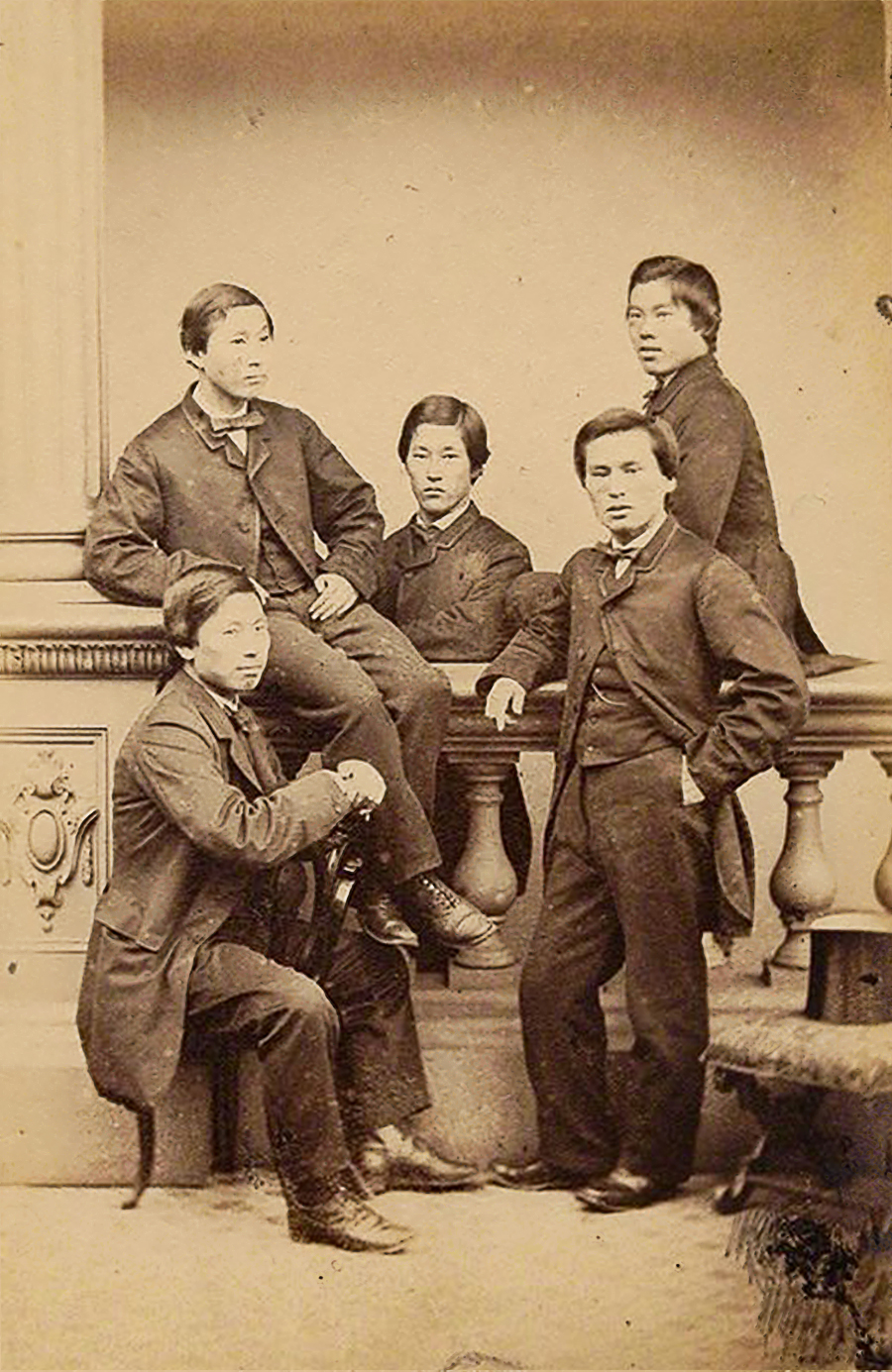
For us, it is really easy to study abroad in our time, compared with the last days of the Edo era. When Japan was closed country, five young Japanese men were dispatched from the Choshu domain to search for the ideal methods of the future of Japan. They would be called “The Choshu Five” later, respecting their courage. Their tremendous will was very strong and amazing. It is often said that their attitudes are just like “live instruments”. I suppose that the simile means to sacrifice even their private feelings. I assure that it can not be explained as simple heroism. I was very interested about people who sought abroad for the way to lead their nation and formed the present Japanese social system. In this article, I will refer to their characteristics and the environment which made their strong will before the voyage first, and then the social background of the last days of the Tokugawa shogunate, and lastly their contribution to Japan in their lifetimes.

At the time the principle of advocating reverence for the Emperor and the expulsion of foreigners was spreading [Editor's note: despite the nominal power of the Emperor, Japan had been ruled since 1600 by the Shogun, and had been closed to most foreign trade and influence]. In those days, the Choshu domain fired at the foreign ships hard and was definitely the base of that movement. Surprisingly, such a domain sent five young people off abroad, breaking a system of national isolation to get the information of the Great Powers of the world. Actually, scholars who had progressive ideas about Japanese foreign relations existed in the Choshu domain. I assure you that the domain was a base of flowering of culture as well as anti-foreign movement.

I should refer to Shoin Yoshida, who was the prime mover of flowering of culture and influenced the Choshu five. Before opening the country, when a fleet which was headed by Commodore Perry came to Japan to get the answer of a treaty of peace and amity, Yoshida hid in an American ship and entreated them to let him to make a voyage to America. Although his action met with failure, the necessity of getting the knowledge of foreign countries was raised.

After his death, many followers who succeeded to his idea stirred up the heads of the Choshu domain, and focused on bringing up able people. I am sure that this factor was one of great motive powers behind fulfilling the Meiji Restoration. The Choshu domain planned the secret passage of the Choshu Five, supported by cooperation of the British consul in Japan.

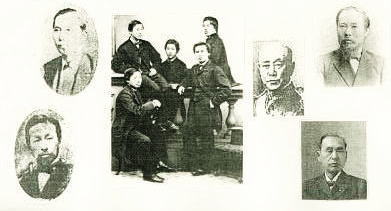
In the background, the five young men were selected to study abroad to London.

The members of the contingent were as follows.

  • Itō Shunsuke (later Prime Minister as Itō Hirobumi), 
  • Inoue Monta (later Foreign Minister as Inoue Kaoru),
  • Yamao Yōzō (later Engineer, Pioneer of education for persons who are deaf and speech-impaired),
  • Endō Kinsuke (later Engineer of Coinage)
  • Nomura Yakichi (later made the first railway in Japan )
Itō was a pupil of Yoshida and was very close to his teacher. Taking over teacher’s will, the voyage was successful.

The Choshu Five were overwhelmed when they arrived in London and saw many huge steamships, trains or big factories. As soon as they arrived, their exclusionism was blown away in an instant. Deploring reckless exclusionism, Ito and Inoue would make every effort to open a country to foreign trade and diplomatic relations later. The others also would be leading figures in the foundation new Japan.

Studying a little, I found that many people’s strong desires had supported the Choshu five. I think that it needed huge bravery to change a nation. I was very moved by their enthusiasm and thought that I also wanted to get strength in my mind like them. I realized that it is important to have a wide vision and be confident in my own will.

Sunday, 4 August 2013

Yoshida Shoin

By Masato Takahashi
Yoshida Shoin
Yoshida Shoin


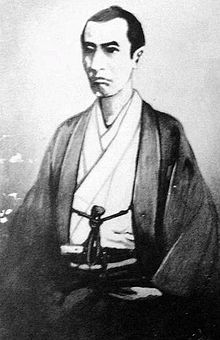
There were many people in Japan who were fascinated by foreign countries, and Yoshida Shoin was one of them. He was known as a samurai of Choshu domain, educator of Ito Hirobumi (the first prime minister of Japan and the philosophical leader of Japan in the Meiji restoration), plus as the one of the people who tried to change Japan. Compared to other people, he was quite unique and had only his way to think differently from ordinary people, which made him remarkable. Many people might wonder whether Yoshida Shoin was great or just crazy, thus in this paper, his story will be introduced in terms of his early life with a reason why he began to be interested in foreign countries, characteristic and actions.

Yoshida Shoin was born on September 20th, 1830 as second son of a modest-ranking samurai family in Choshu region. When he was 11 years old, his talent of military studies was improved in Shokason-zyuku cram school, and he was admired by Takachiika Mouri who was a leader of Choshu Domain at that time. However after First Anglo-Chinese war in 1850, he was overwhelmed by the strength of western countries and felt strongly that Japan needed to learn the military studies of western countries. For this, he started to be fascinated by western countries.

Yoshida Shoin was a quite extraordinary-thinking man because he was never afraid of any penalty and neither cared about it in order to achieve his purpose. Here are some examples of his story. In 1852, he and his friend, Teizou Miyabe, a samurai of Kumamoto domain planned to travel Tohoku area in the north east of Japan, but on this travel Shoin quit being a samurai of Choshu domain and abandoned his status not to be late for the travel day, and at last, after this travel which is called ‘Tohoku yu-gaku’, he was penalized. Moreover, in 1854 when Matthew Calbraith Perry came to Japan in second time in order to make a treaty with Japan, Yoshida tried to get in Perry’s ship to ask for passage overseas in secret, but his wish was denied and he was arrested. As these things show, he was quite crazy and did not think of the result after his action.

Yoshida Shoin tried to do many things which were quite crazy, for example as mentioned in the previous paragraph, his trip to Tohoku area or making contact with Matthew Perry. In addition to these actions, there were many other actions, for instance in 1853 he planned but failed to get in a Russian war ship of Jevfimij Vasil'jevich Putjatin to study abroad, because he had been very impressed with western countries’ power when Matthew Perry came to Japan for the first time. Moreover, in 1858, after USA and Japan made ‘Treaty of Amity and Commerce’ without permission from an emperor, he got furious, thought that the biggest obstacle of Japan was its own government and decided to beat Japanese government. However he was arrested again and ended up being executed when he was 30 years old.

In conclusion, seemingly Yoshida Shoin was just crazy and there might not be any specific purpose to do such crazy actions as introduced before, however it is also true that he cared about Japan more than anything and truly loved it. As an educator, he raised Ito Hirobumi and Takasugi Shinsaku who left great feats in Japan, as a revolutionary he dedicated himself to studying western countries and conducted crazy deeds and never was afraid of being punished to improve Japan. In history, there were many people who tried to make changes for their country by knowledge from western countries, and Yoshida Shoin was just one of them. When he died, he left this remark “吾れ今 国の為に死す 死して 君臣に背かず 悠々たり 天地の事 鑑照 明神にあり” which means “I’ll die for my country. Even after I die, I appreciate everything to my lord and my parents, plus I never betray myself and what I’ve done. The world is immortal and broad. Oh, God, please prove that what I’ve done was right” (Yoshida Shoin.com). He always did his best to bring changes to Japan because of his love for Japan which might be little unique, therefore he was truly one of great patriots of Japan.


Reference

吉田 松陰.com (Yoshida Shoin. com). 
Retrieved from http://www.yoshida-shoin.com/

Friday, 2 August 2013

Mori Arinori

Mori Arinori
Mori Arinori
By Eri Yamashita

Mori Arinori is well known in Japan for his achievements of setting education system and his radically westernized way of thinking. 

First of all I’m going to describe how his life was going along timeline. He was born in Satsuma domain (now Kagoshima) to a high-ranking samurai family. He was the fifth boy. Because his family was wealthy, he got educated well. When he was 13 years old, which is now the age of enrollment of junior high school, he started studying kanngaku (Chinese ancient study) and 4 years later, he enrolled at Kaiseizyo where students studied Western learning. It is said that this school is the basis of the Tokyo University. There, he took a class about studies of British literature. When he turned 18 years old, he went to London to study. Later, he also studied in Washington. During these stays, he got interested in Christianity.

After the Meiji restoration, he went back to Japan and he set up a group named Meirokusha with other historical important men, such as Fukuzawa Yukichi or Saishu. This group was meant to do enlightenment activities. He became the first leader of this group and published many literatures. In 1875, he founded a private school called Syouhou Kousyuuzyo (which is now known as Hitotsubashi University). In this year, he married a Japanese woman, Hirose Tsune. It is said that this was the very first contract marriage in Japan. 

While he worked in London as an ambassador to Great Britain, Ito Hirobumi visited him and they had discussions about Japan’s future. Mori insisted that education is the first thing that Japanese government should work on first to build a strong country. Ito was impressed by his passion and he accredited Mori as a first minister of education as he got a Cabinet in a place. Even after Ito’s Cabinet ended, he stayed on his post of the education minister. While he worked for Prime Minister Kuroda Kiyotaka, he set an academic degree system. This is still a basis of present education system. 

In 1899, at the age of 43, on the day of promulgation of the constitution, he was changing his clothes for the ceremony, he was attacked and stabbed by an ultranationalist and he died the next day. 

Now, I want to give a little focus on the education area, starting off with his idea of education. His idea was basically education is ultimately to enrich the country, known as Fukoku Kyouhei (rich country, strong army), by giving appropriate knowledge evenly to boys and girls. Some researchers have pointed out that he thought that school is a place to choose good students to become soldiers for the policy. 

Because of his extremely westernized thoughts, he once even suggested that we should stop using Japanese and change the public language to English. 

Now about the assassination, there are some rumors about the cause of this incident that he was regarded as extremely westernized so that he didn’t take off his shoes when he entered a famous shrine in Ise and he pushed aside a curtain with his walking stick which only the emperor can touch. However many reseachers deny all these rumors. The guy who attacked him also got killed at the time he killed Mori so truth will never come to light.

Needless to say, his thoughts were not same as most other Japanese people. Only a few wealthy Japanese people learned Western studies and most of Japanese didn’t agree on his radical Westernized ideas. That might have been caused him many difficulties. However he still contributed to make Japan modernized and distribute education evenly to boys and girls.